UMN:CLI User Manual
V5808
488
Shortest Path Tree (SPT)
When the number of receivers increases, a shared tree may not be entirely efficient, so
PIM-SM also provides the option to switch to receive multicast traffic on a shortest path
tree (SPT). When this option is enabled, on receiving the first multicast packet from the
RP in response to the PIM join message, the switchover to the SPT then occurs.
To establish the SPT to the multicast source, the DR sends the join message with (S, G)
state toward that source. When the SPT between the receiver and source is established,
and multicast traffic is sent via that distribution tree, the DR sends the prune message
with (*, G) state toward the RP to prune the existing shared tree to receive the traffic.
SPT is established based on the existing unicast routing table by performing the RPF
check. It has a different distribution tree for every multicast source, allowing the efficient
network traffic flows, but more resources are needed for each multicast routers to
maintain (S, G) states.
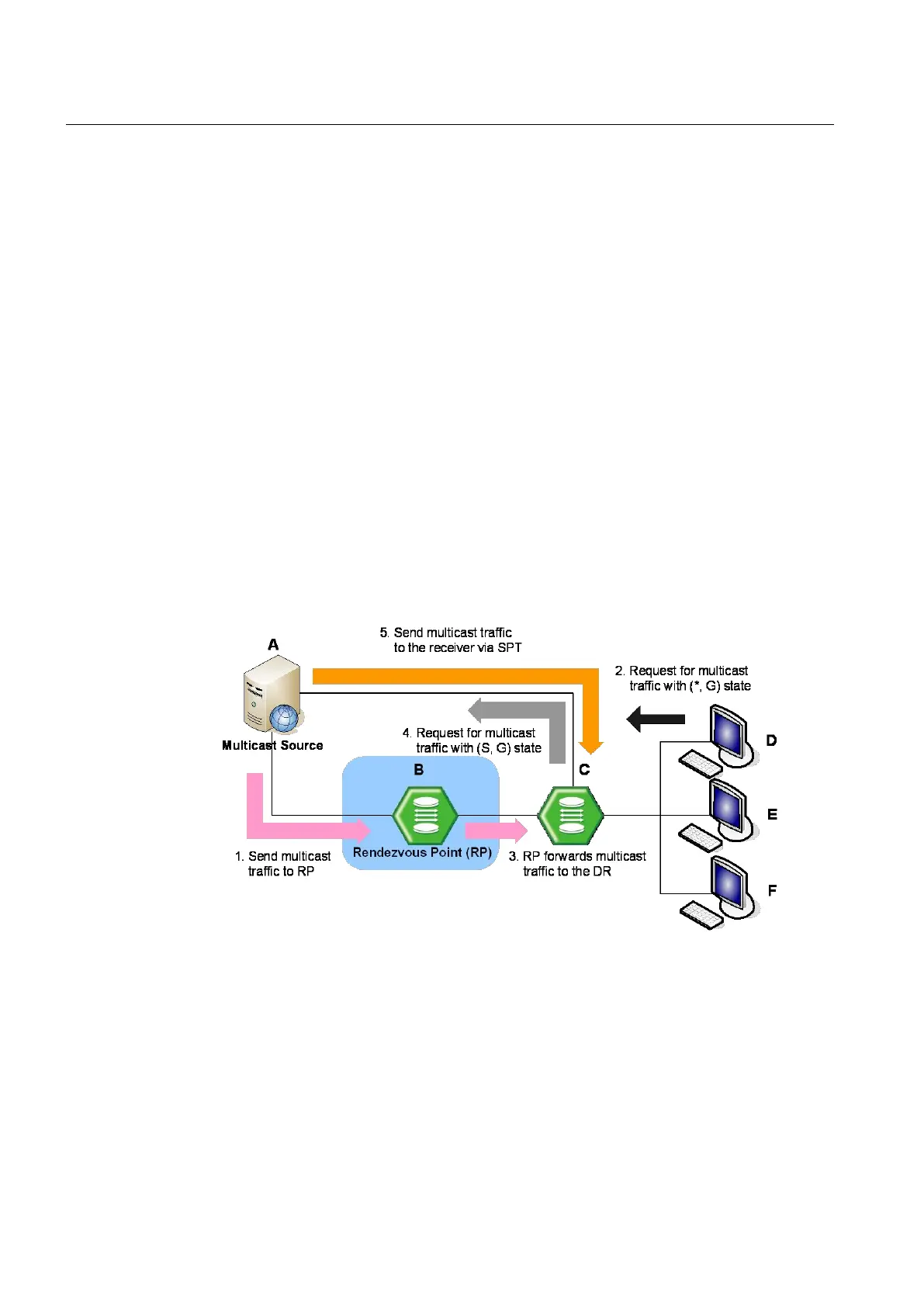
Fig. 10.5 shows an example of the SPT switchover. The multicast traffic from the source A
initially attempts to flow through the router B and C to the receiver D that indicates the
interest in the multicast group. Once the traffic arrives at the router C which is the DR, it
sends the join message with (S, G) state toward the source A to build the SPT between
the source and receiver. The source A then sends the multicast traffic to the receiver D
via the SPT by deleting unnecessary hops. Finally, the distribution tree (SPT) built by the
RPF check is A→C→D.
Fig. 10.5 Shortest Path Tree
PIM Messages
The followings are simple descriptions of PIM control messages:
• Hello
PIM routers periodically send hello messages on all interfaces to discover neighbor-
ing PIM routers and to determine which router will be the DR for each subnet.



 To Next Page