User Manual UMN:CLI
V5808
487
If the RP has receivers interested in the group, the RP must receive the multicast traffic
from the source of that group via the SPT to deliver the traffic to those receiver. The DR of
the source encapsulates the multicast packets in the PIM register messages, and starts to
unicast them to the RP. On receipt of the register messages, the RP sends the join
message with (S, G) state toward the source to establish the SPT. When receiving the
multicast traffic via the established SPT, the RP forwards the traffic toward those
receivers.
Multicast traffic may be directly delivered from sources to receivers via the SPT using the
switchover mechanism. For more information, see Section 10.3.6 IPv6 SPT Switchover
Rendezvous Point Tree (RPT)
PIM-SM mainly uses a shared tree to deliver multicast traffic, called the RP tree (RPT). As
its name implies, it relies on a core router called the Rendezvous Point (RP) that receives
all multicast traffic from the sources and forwards that traffic to the receivers. Other
routers do not need to know the information of the sources. All they need to know is the
address of the RP, because the RP surely knows the information of the sources for all
multicast groups. Thus, receivers who are interested in a certain multicast group only
send PIM join messages with (*, G) state toward the RP.
The shared tree is unidirectional, which means all multicast traffic flows only from the RP
to the receivers. Thus, there is no guarantee that the shared tree (RPT) is the shortest
path tree to the source, and most likely it is not, resulting in longer delays, but less
forwarding states to maintain.
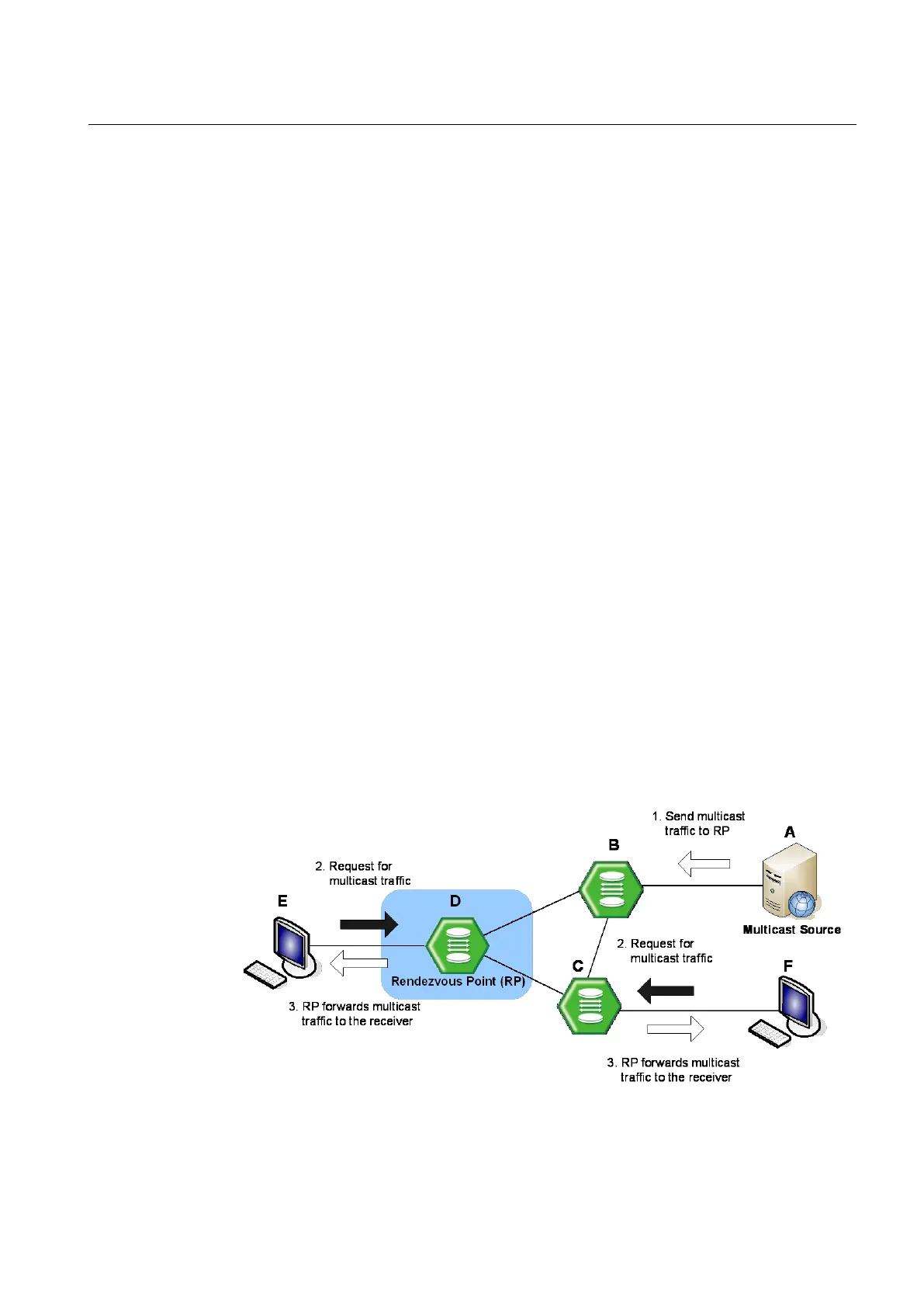
Fig. 10.4 shows an example of the RPT network. The multicast traffic from the source A
flows through the router B to the router D which is the RP. Note that, even in the RPT,
RPs must receive multicast traffic from the sources via the shortest path. The RP then
distributes the traffic to the receiver E and F that indicate the interest in the multicast
group. Consequently, the distribution tree for the receiver E is A→B→D→E, and the one
for the receiver F is A→B→D→C→F.
Fig. 10.4 Rendezvous Point Tree


 To Next Page