P.2.43
Date Code 20151029 Protection Manual SEL-411L Relay
Installation
Connection
Communications
Network Connections
The optional Ethernet card for the relay can use either the connection on Port C
or Port D to operate on a network. These ports can work together to provide a
primary and backup interface. Other operating modes (FIXED and
SWITCHED) are also available. The following list describes the Ethernet card
port options.
➤ 10/100BASE-T. 10 Mbps or 100 Mbps communications using
Cat 5 cable (category 5 twisted-pair) and RJ45 connector
➤ 100BASE-FX. 100 Mbps communications over multimode
fiber-optic cable using LC connector
Ethernet Card Rear-Panel Layout
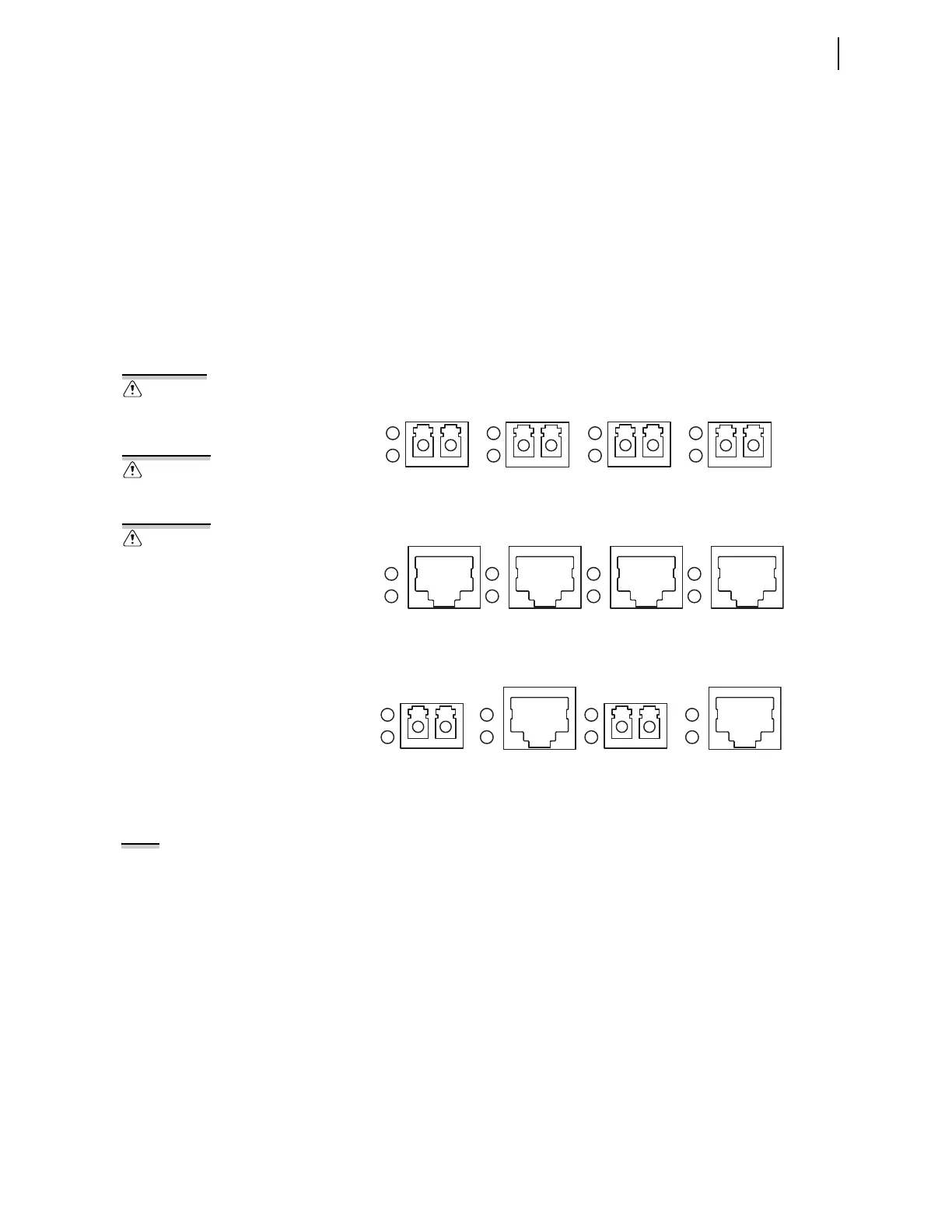
Rear-panel layouts for the three Ethernet card port configurations are shown in
Figure 2.39–Figure 2.41.
Figure 2.39 Four 100BASE-FX Port Configuration
Figure 2.40 Four 10/100BASE-T Port Configuration
Figure 2.41 100BASE-FX and 10/100BASE-T Port Configuration
Twisted-Pair Networks
NOTE: Use caution with UTP cables
as these cables do not provide
adequate immunity to interference in
electrically noisy environments unless
additional shielding measures are
employed.
While Unshielded Twisted Pair (UTP) cables dominate office Ethernet
networks, Shielded Twisted Pair (STP) cables are often used in industrial
applications. The relay Ethernet card is compatible with standard UTP cables
for Ethernet networks as well as STP cables for Ethernet networks.
Typically UTP cables are installed in relatively low-noise environments
including offices, homes, and schools. Where noise levels are high, you must
either use STP cable or shield UTP using grounded ferrous raceways such as
steel conduit.
Several types of STP bulk cable and patch cables are available for use in
Ethernet networks. If noise in your environment is severe, you should consider
using fiber-optic cables. We strongly advise against using twisted-pair cables
for segments that leave or enter the control enclosure.
If you use twisted-pair cables, you should use care to isolate these cables from
sources of noise to the maximum extent possible. Do not install twisted-pair
Use of controls or adjustments, or
performance of procedures other than
those specified herein, may result in
hazardous radiation exposure.
Do not perform any procedures or
adjustments that this instruction
manual does not describe.
Incorporated components, such as
LEDs, transceivers, and laser emitters,
are not user serviceable. Return units
to SEL for repair or replacement.
ACT
PORT 5C PORT 5DPORT 5BPORT 5A
LNK
ACT
LNK
ACT
LNK LNK
ACT
ACT
PORT 5DPORT 5CPORT 5A PORT 5B
LNK
ACT
LNK
ACT
ACT
LNK
ACT
LNK
ACT
PORT 5DPORT 5CPORT 5A PORT 5B
LNK LNK
ACT
ACT
LNK LNK
ACT
ACT


 To Next Page