P.3.129
Date Code 20151029 Protection Manual SEL-411L Relay
Protection Functions
Fault Location
At this point, if the relay is in outstation mode or has degraded 87L
synchronization, the calculation reverts to the single-ended method and uses
the local negative-sequence current instead of the differential current for
polarization of fault location.
Note that in the case depicted in Figure 3.77, the T2 relay calculates the true
fault location because the fault is on its local section. The fault is outside of
the local sections for the T1 and T3 relays so their fault locators will calculate
results greater than 1 pu.
To facilitate faulted line section selection and consistent numerical fault
location reporting, the relays exchange fault location results they obtained
with Equation 3.71. This exchange occurs via a “background communications
channel” embedded in the 87L data over the 87L physical channel. This
patent-pending method provides limited bandwidth, but it is sufficient for
applications such as fault location. Most importantly, this method is very
efficient and secure in terms of not affecting 87L data traffic. By using the
background communications channel, each relay in the Figure 3.77 example
can access the fault location calculations of its peers. As a result, each relay
concludes that the fault is on the T2-T section of the line, at the numerical
location m from the T2 terminal, as the T2 relay calculates in pu of the T2-T
section length.
This approach to multi-ended fault location has the following advantages.
➤ The relays use the double-ended method in Equation 3.68
when 87L is precisely synchronized, but they use the single-
ended method in Equation 3.67 as a fallback. This selection of
method, which occurs on a per-relay basis, maximizes
accuracy and allows outstation relays (if any are in the 87L
scheme) to support the fault location and faulted-section
identification.
➤ Faulted-line section identification is always possible as long as
there is one master in the 87L scheme, even if the quality of
87L synchronization is poor.
➤ The information the relays exchange for the benefit of fault
location is minimal. In particular, no permanent payload is
added to every 87L packet and shared information consists of
just a single real number that needs no further processing,
averaging, window selection, etc.
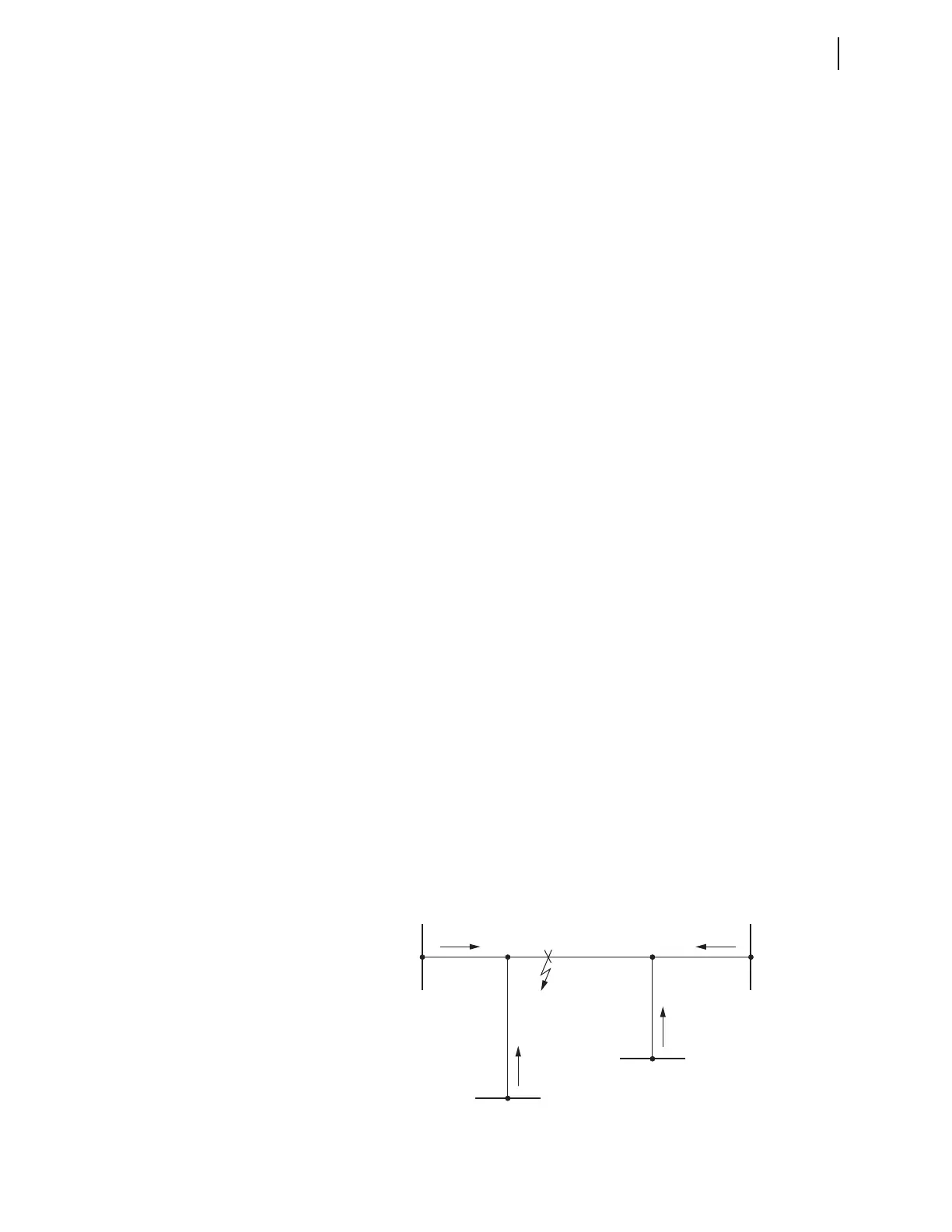
In four-terminal applications (see Figure 3.78), each relay first assumes that
the fault is on its adjacent line section. If this hypothesis is true, the relays
report the faulted-line section and the numerical fault location, as in the case
of a three-terminal line.
Figure 3.78 Fault Location on Four-Terminal Lines
I
T4
I
T2
I
T1
Z
T4
Z
PQ
V
T4
Z
T1
V
T1
Z
T2
V
T2
T2T1
T4
P
I
T3
Z
T3
V
T3
T3
Q


 To Next Page