P.9.9
Date Code 20151029 Protection Manual SEL-411L Relay
Monitoring and Metering
Circuit Breaker Monitor
As in Example 9.4 (connection of the trip bus to a control input), you can also
capture the circuit breaker close information by using a relay input to monitor
the close bus for the given circuit breaker.
Other Circuit Breaker
Monitor Functions
kA Interrupt Monitoring
The relay monitors the amount of phase current that each pole of the circuit
breaker interrupts at each trip operation. The relay records the interrupted
current as a percentage of the circuit breaker maximum interrupting rating
specified by the manufacturer. Set the maximum interruption current with
setting B1MKAI (Maximum kA Interrupt Rating—BK1). If the percent of
current interrupt that the relay records exceeds threshold setting B1KAIAT
(kA Interrupt Capacity Alarm Thresh—BK1), the relay asserts breaker
monitor alarm Relay Word bit B1KAIAL.
Mechanical Operating Time
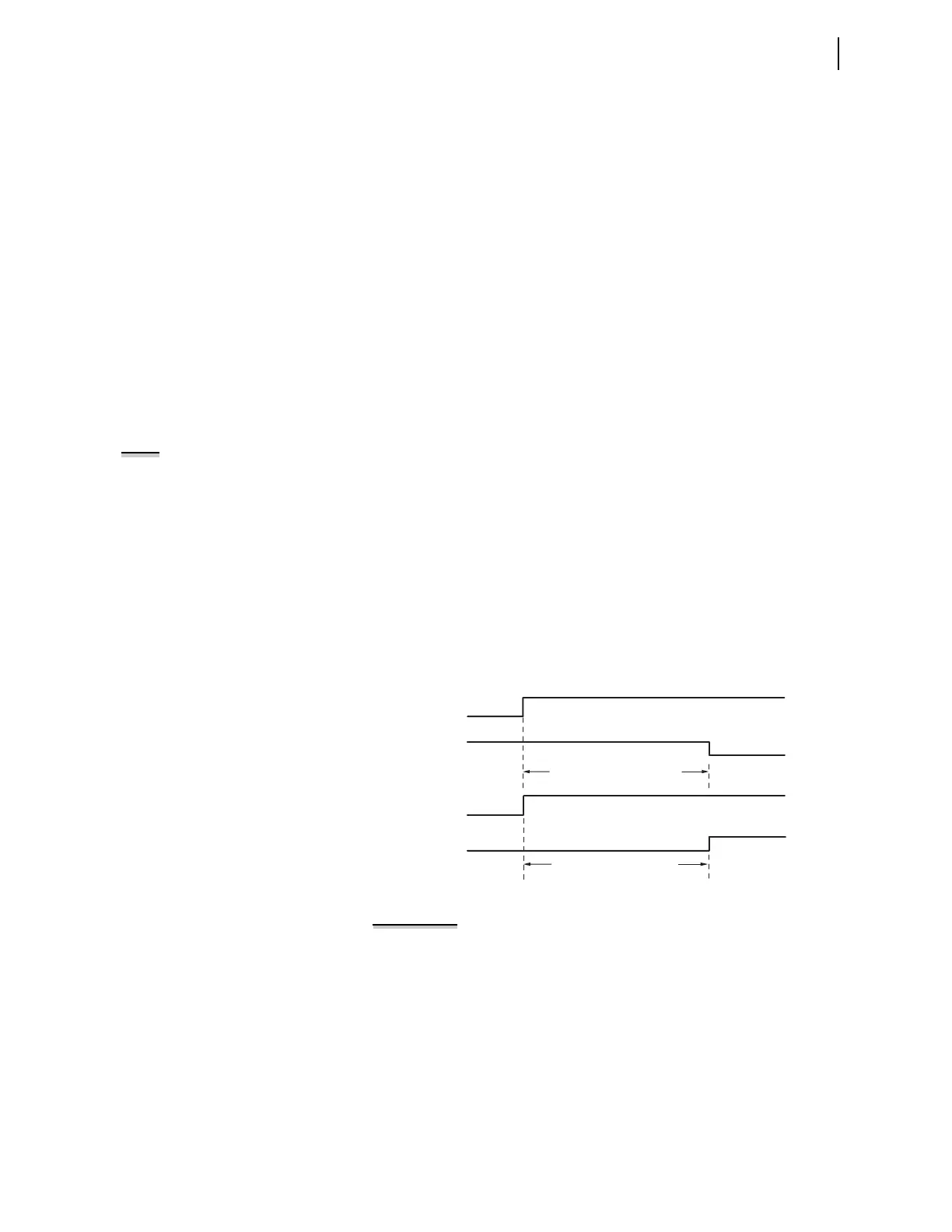
The mechanical operating time is the time between trip initiation or close
initiation and the associated phase circuit breaker 52A normally-open contact
status change. (Assertion of 52A indicates that a particular circuit breaker
phase has closed). The relay measures the tripping times for each phase from
the assertion of the respective BM1TRP Relay Word bit to the dropout of the
respective 52A1 Relay Word bit. Similarly, for mechanical closing time, the
relay measures the closing times for each phase from the assertion of the
BM1CLS Relay Word bit to the pickup of the 52A1 Relay Word bit. The
relay compares these tripping or closing times to the mechanical slow
operation time thresholds for tripping and closing, B1MSTRT and B1MSCLT,
respectively. The relay issues a mechanical slow operation alarm, B1MSOAL,
for 5 seconds when trip or close times exceed these thresholds. See Figure 9.5
for a Circuit Breaker 1 A-phase timing diagram.
Figure 9.5 Mechanical Operating Time for Circuit Breaker 1 A-Phase
EXAMPLE 9.5 Mechanical Operating Time Settings
Use Circuit Breaker 1, a single-pole tripping circuit breaker, for this
example. Connect the circuit breaker normally-open 52A contacts
through station battery power to IN201, IN202, and IN203. This
example uses inputs IN201, IN202, and IN203 for phases A, B, and C,
respectively; you can use any control inputs that are appropriate for
your installation. The control voltage for this example is 125 Vdc.
Control Inputs IN201–IN203 are located on the relay main board and
are direct-coupled inputs.
This section lists settings for Circuit
Breaker 1; settings for Circuit Breaker
2 are similar; replace 1 in the setting
with 2.
BM1TRPA
(Phase A Trip)
52AA1
Mechanical Tripping Time
BM1CLSA
(Phase A Close)
52AA1
Mechanical Closing Time


 To Next Page