P.3.303
Date Code 20151029 Protection Manual SEL-411L Relay
Protection Functions
87L Time Fallback Logic
Time Fallback Mode 2
This fallback mode discredits current data when it is impossible to use such
data because of a lack of synchronization. In this way, the 87L scheme in the
2SD and 3SM configurations can adapt as if the channel were lost and
continue providing 87L protection if other conditions are favorable.
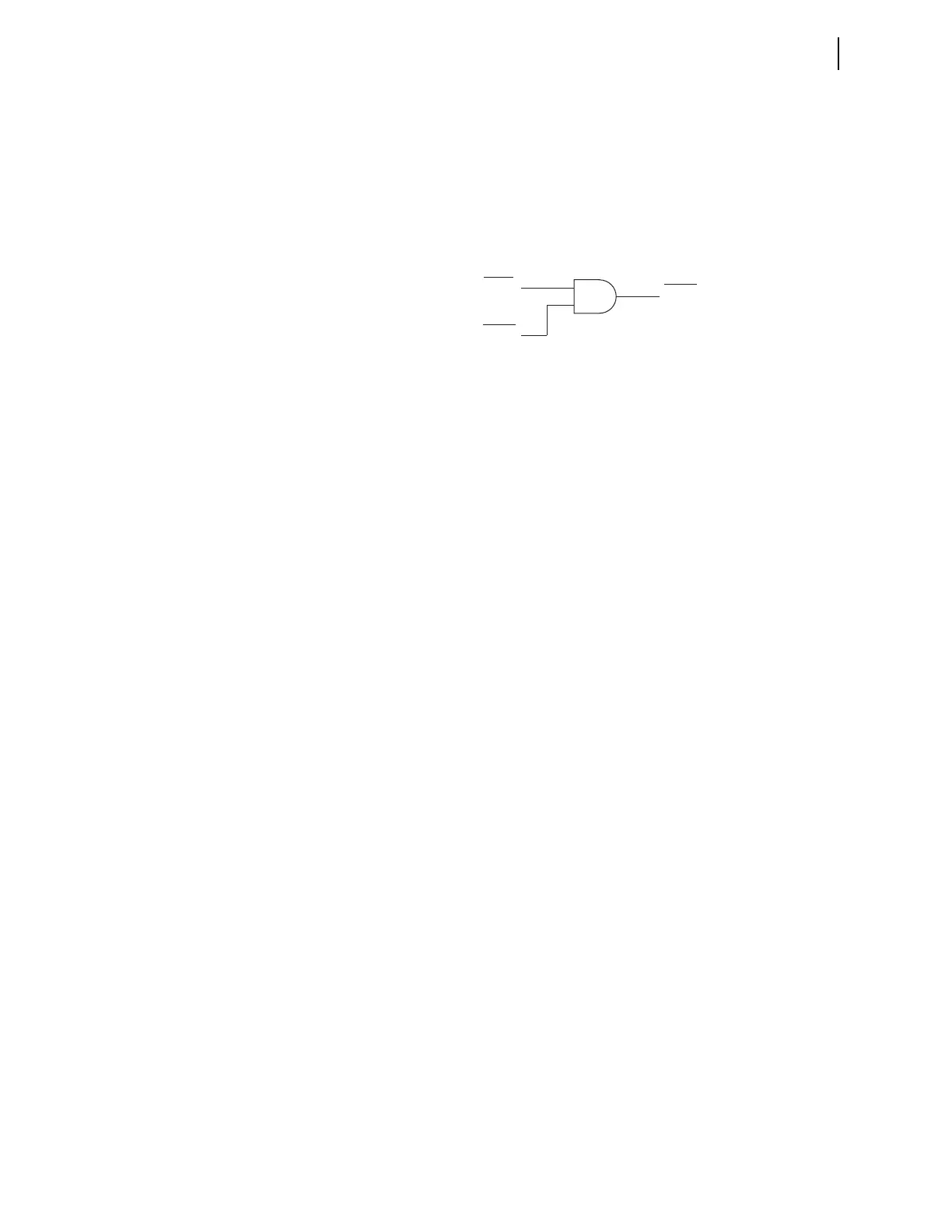
The relay achieves this time fallback mode, as Figure 3.212 shows, by
asserting Relay Word bits that force out the channel for which the relay
requested time fallback.
Figure 3.212 Time Fallback Mode 2 Logic
The relay uses 87CHpFO Relay Word bits to mark the p-th channel as
unusable. This leads to the following 87L scheme response.
E87CH = 2SS—both relays declare the channel to be unusable, and the 87L
function becomes unavailable. The 87LST Relay Word bit (see 87L Master,
Outstation, and Loss of Protection Logic) signals this unavailability.
E87CH = 2SD—if the channel in use calls for time fallback, and the other
channel is usable, the 87HSB logic switches to the other channel. If the stand-
by channel is unusable, the 87L function becomes unavailable. If the stand-by
channel loses time, no action occurs, because the hot stand-by channel is not
necessary. However, the 87CHpNS bit asserts to indicate that no
synchronization is available for this channel. Should the channel in use require
switchover, the relays will not switch to the hot stand-by channel because this
channel is not synchronized (see 87L Standby Channel Switchover Logic for
more information on the hot stand-by logic).
E87CH = 3SM—both relays that use the channel calling for fallback declare it
unusable, the system switches to a master-outstation mode if other channels
permit, or the 87L function becomes unavailable. The 87MTR, 87SLV, and
87LST Relay Word bits signal the actual response to indicate the master,
outstation, and loss of 87L function states. The two relays connected with the
channel calling for time fallback will at least become slaves (87SLV asserted).
The third relay will remain a master (87MTR asserted), if the other two
channels do not call for fallback and are operational. If the other two channels
are also unusable, the 87L function becomes unavailable (87LST asserted at
all three terminals).
Time Fallback Mode 3
This fallback mode checks whether the channel calling for time fallback was
symmetrical at the moment it lost the external time reference. In the external
time-based synchronization mode, the relays can measure channel asymmetry.
Time fallback Mode 3 uses the value of channel asymmetry the relays
measured just prior to losing the external time reference to decide how to
respond.
For small asymmetry, the relays will force data synchronization for the
affected channel to use the channel-based mode. This is a safe approach,
because the channel-based method works well for symmetrical channels. For
significant asymmetry, the fallback logic in Mode 3 forces out the channel.
Effects are similar to those in fallback Mode 2.
As Figure 3.213 shows, the fallback logic makes a one-shot decision at the
moment the channel calls for fallback. The following occur at that time.
Relay
Word Bit
Relay
Word Bit
Setting
87CHpFB
87TFB = 2
87CHpFO


 To Next Page