P.3.25
Date Code 20151029 Protection Manual SEL-411L Relay
Protection Functions
87L Theory of Operation
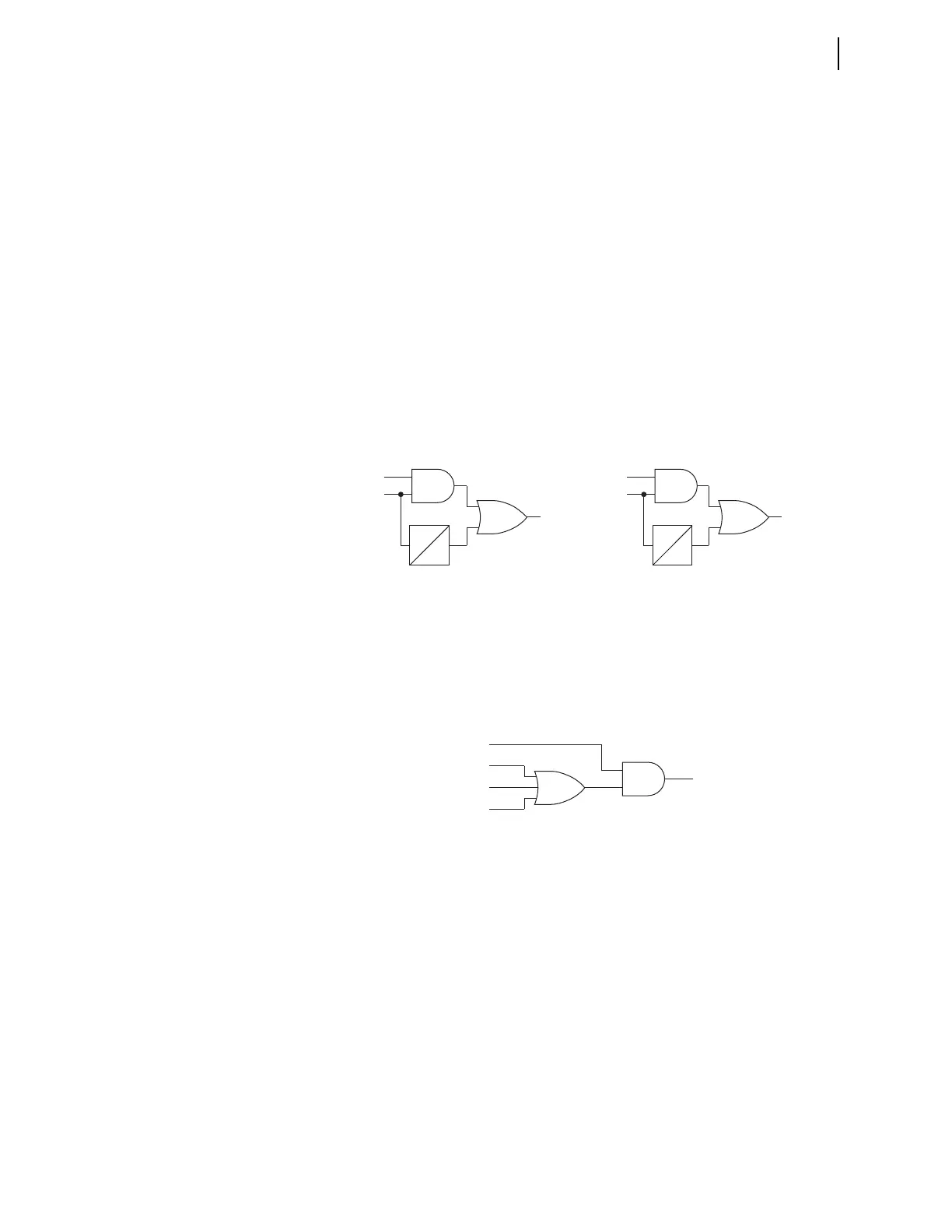
Refer to Figure 3.15 for a preferred solution that involves ultra-sensitive and
fast disturbance detection logic supervising both the current-based 87L
operation and the execution of the received 87 Direct Transfer Trip bit
(87DTT). In addition, it is advisable to use the channel monitoring and
alarming features of the relay to detect excessive noise in the 87L channel and
attend to any such problem before defeat of the constantly stressed BCH
check combined with an accidental system event that could activate the
disturbance detection logic.
Note that corrupted data that would activate the raw 87L function or
spuriously assert the received 87DTT bit would be short lived, typically just a
single packet. In the case of the 87L function, two power cycles are sufficient
to flush the corrupted data out of the windows of the 87L digital filters. In the
case of the received 87DTT command, there exists a very low probability that
more than two consecutive packets would defeat the BCH. Therefore, the
relay uses a time delay approach when supervising the 87L with disturbance
detection—the operation is instantaneous if disturbance detection confirms
the fault. The relay delays the operation only slightly if the disturbance
detection fails to pick up. This precaution maximizes dependability while still
fulfilling the primary purpose of the disturbance detection supervision.
Figure 3.15 Application of Disturbance Detection in the Relay
The disturbance detection algorithm responds to both local and remote
quantities and is augmented by the stub bus condition and test mode (see
Figure 3.16). In the stub bus situation, the remote signals are not a part of the
87L zone, so the relay permits remote disturbance detection by default. Under
test conditions, the remote relays may or may not be injected with currents.
Therefore, the 87L function receives supervision only from the local
disturbance detection.
Figure 3.16 Local (87DDL) and Remote (87DDR) Disturbance Detection
Harmonized With the Stub Bus (ESTUB) and Test (87TEST) Conditions
The local disturbance detector (87DDL) responds to sequence currents (zero-
and positive-sequence) and voltages (zero-, negative-, and positive-sequence).
The detector uses voltages to account for weak infeed conditions. It does not
use voltages if the relay declares a loss of potential. Following detection of a
disturbance, the 87DDL bit asserts for a minimum of 10 power cycles.
The disturbance detector takes local signals necessary for 87DDL logic prior
to alignment of these signals. This allows the detector to operate faster,
because it does not need to delay local data for alignment with the remote
signals. Also, because it is independent from the alignment table, the local
disturbance detector guards against possible issues with data alignment that
might result from any unusual behavior of the 87L communications channel.
The remote disturbance detector (87DDR) responds to zero-, negative-, and
positive-sequence components of all remote currents. If a given current is very
low, such as upon the remote breaker being opened, or under weak infeed
2
CYC
0
87DD
Raw 87L
87L
(To Trip Logic)
0.75
CYC
0
87DD
Raw
87DTTRX
87DTTRX
(To Trip Logic)
87DD
87DDL
87DDR
87TEST
ESTUB


 To Next Page