P.3.122
SEL-411L Relay Protection Manual Date Code 20151029
Protection Functions
Time-Error Calculation
Time-Error Calculation
Description and
Settings
The Time-Error calculation function in the relay measures the amount of time
that an alternating current (ac) clock running from the same line frequency
measured by the relay would differ from a reference clock. The relay
integrates the difference between the measured power system frequency and
the nominal frequency (Global setting NFREQ) to create a time-error analog
quantity, TE.
A correction feature allows the present time-error estimate (TE) to be
discarded, and a new value (TECORR) loaded when SEL
OGIC control
equation LOADTE asserts. For example, if the TECORR value is set to zero,
and then LOADTE is momentarily asserted, the TE analog quantity will be set
to 0.000 seconds.
The TECORR analog quantity can be pre-loaded by the TEC Command (see
TEC on page P.15.57), or via DNP3, object 40, 41 index 01 (see Table 4.10).
In either case, Relay Word bit PLDTE asserts for approximately 1.5 cycles to
indicate that the preload was successful.
A separate SEL
OGIC control equation, STALLTE, when asserted, causes time-
error calculation to be suspended.
Table 3.58 lists the inputs and outputs of the time-error function.
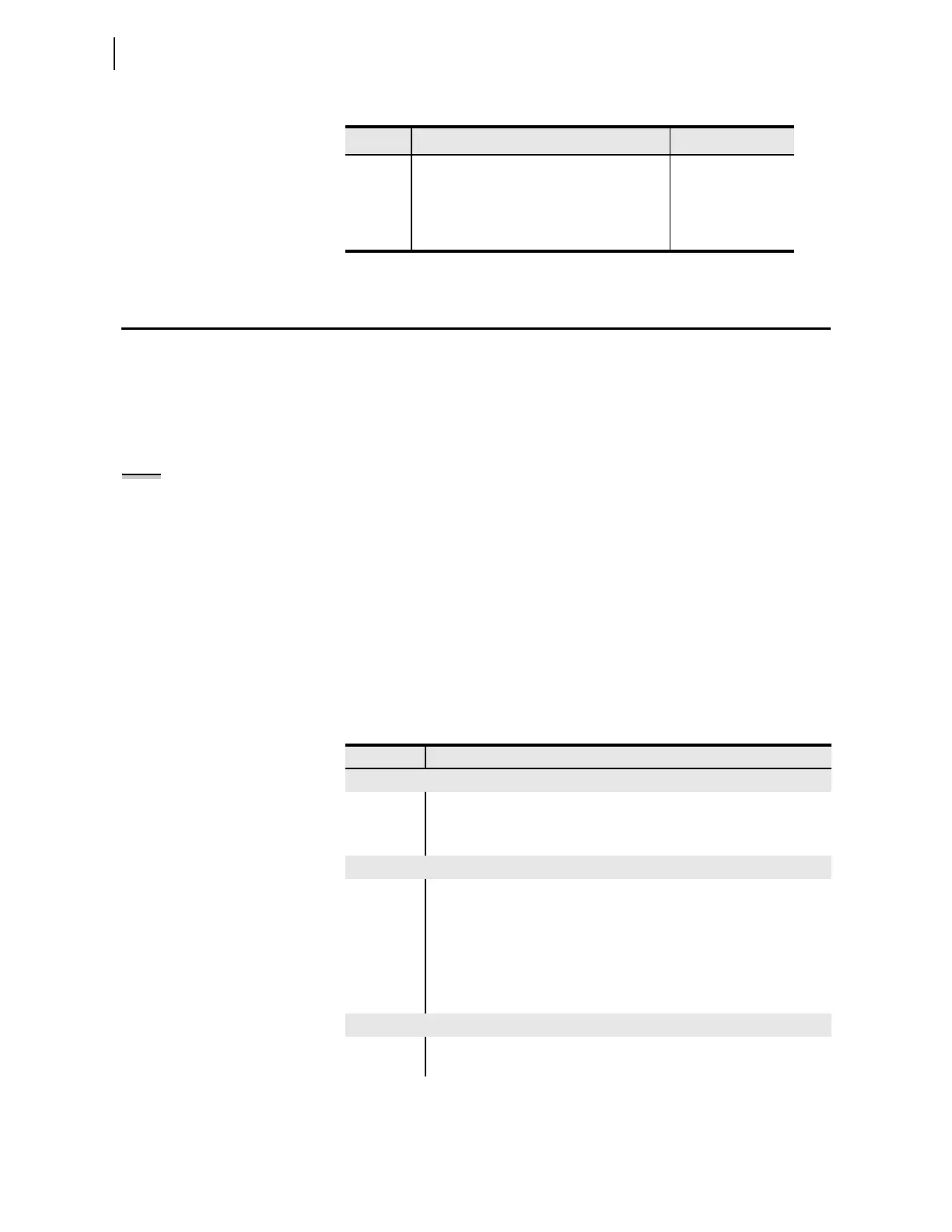
Table 3.57 Frequency Estimation Outputs
Name Description Type
FREQ Measured system frequency (Hz) (40–65 Hz) Analog Quantity
FREQP Measured frequency (Hz) (20–80 Hz) Analog Quantity
FREQOK Measured frequency is valid Relay Word bit
FREQFZ Measured frequency is frozen Relay Word bit
Table 3.58 Time-Error Calculation Inputs and Outputs (Sheet 1 of 2)
INPUTS Description
Analog Quantities
FREQ Measured system frequency (see Table 3.57)
TECORR Time-error correction factor. This value can be preloaded via the TEC
command, or DNP3
Global Settings
NFREQ Nominal frequency (see Table 5.4)
LOADTE Load time-error correction factor (SEL
OGIC control equation). A rising
edge will cause the relay to load the TECORR analog quantity into TE.
LOADTE has priority over STALLTE.
STALLTE Stall time-error calculation (SEL
OGIC control equation). A logical 1 will
stall (freeze) the time-error function. The TE value will not change when
STALLTE is asserted (unless LOADTE asserts).
Relay Word bit
FREQOK Frequency measurement valid. If this Relay Word bit deasserts, the TE
quantity is frozen (see Table 3.57).
NOTE: The LOADTE SELOGIC control
equation is processed once per cycle.
A momentary assertion must be
conditioned to be at least one cycle
in duration. A rising edge operator
(R_TRIG) should not be used in the
LOADTE setting.


 To Next Page