P.13.3
Date Code 20151029 Protection Manual SEL-411L Relay
Time-Synchronized Measurements
Configuring High-Accuracy Timekeeping
This example assumes that you have successfully established communication
with the relay (see Making an EIA-232 Serial Port Connection on
page P.10.5). In addition, you must be familiar with relay access levels and
passwords (see Changing the Default Passwords: Terminal on page P.10.9 to
change the default access level passwords).
Step 1. Confirm that the relay is operating (see Connecting and
Applying Power on page P.10.3).
Step 2. Prepare to control the relay at Access Level 2.
a. Using a communications terminal, type ACC <Enter>.
b. Type the Access Level 1 password and press <Enter>.
You will see the Access Level 1 => prompt.
NOTE: Consult the specific GPS
Clock (IRIG-B time source) instruction
manual for the IRIG-B cable
requirements, termination resistor
requirements, antenna installation,
and clock configuration details.
Step 3. Connect the cable.
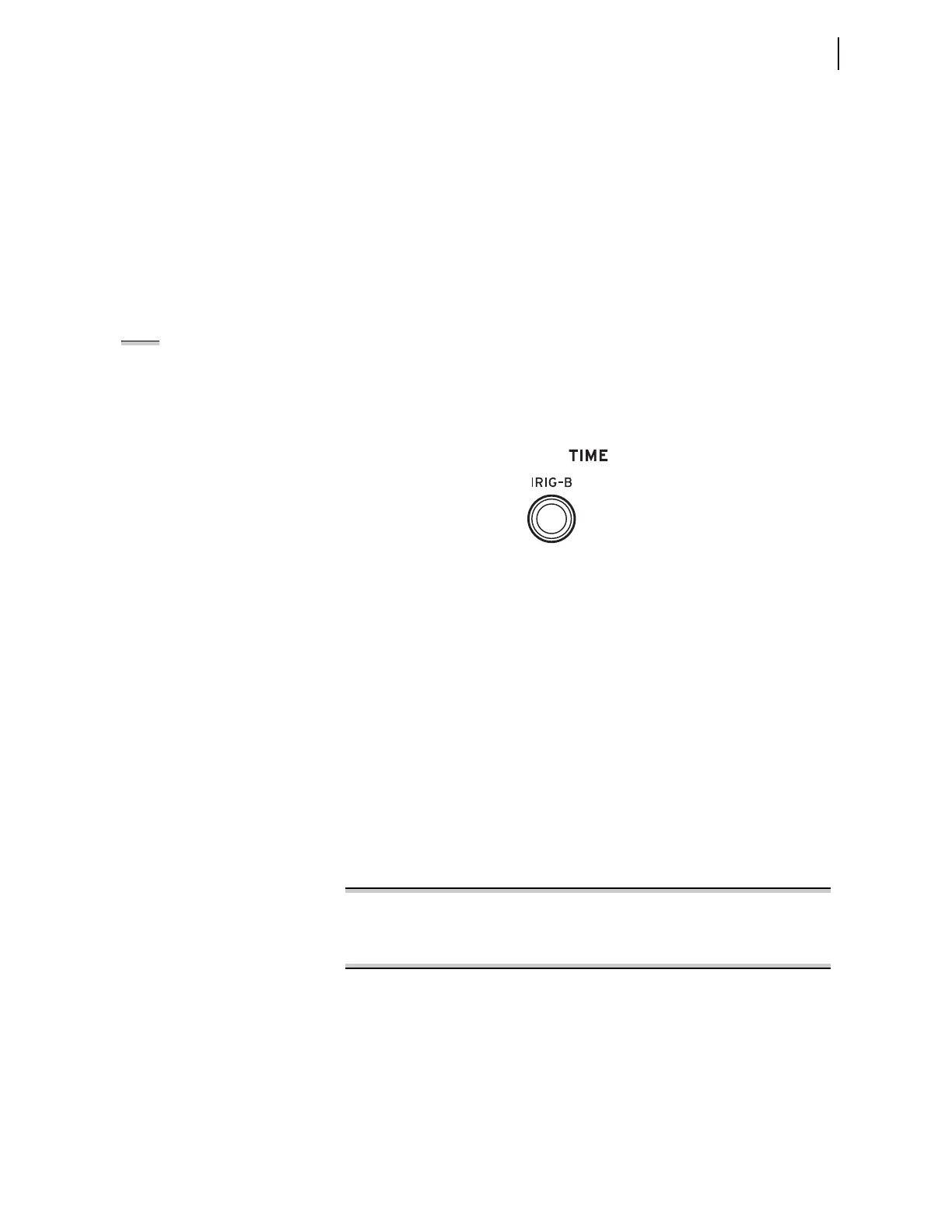
Attach the IRIG-B signal with a BNC-to-BNC coaxial jumper
cable from the GPS receiver IRIG-B output to the relay TIME
IRIG-B BNC connector (see Figure 13.1).
Figure 13.1 TIME BNC Connector
Step 4. Confirm/enable automatic detection of high-accuracy
timekeeping.
a. Wait at least 20 seconds for the relay to acquire the
clock signal, and then, at a communications terminal,
type TAR TIRIG <Enter>.
The relay will return one row from the Relay Word, as
shown in Figure 13.2. Only the state of the TIRIG and
TSOK Relay Word bits are discussed in the
troubleshooting steps below. The other Relay Word bits
of interest to this discussion are TUPDH, which
indicates that the relay internal clock is presently being
updated by the HIRIG source, and TSYNCA, which
acts as an alarm bit that asserts when the relay is not
synchronized to either an internal or an external source.
TSYNCA will only assert briefly when the HIRIG time
source is connected or disconnected.
=>TAR TIRIG <Enter>
* * TIRIG TUPDH TSYNCA TSOK PMDOK FREQOK
0 0 1 1 0 1 1 0
=>
Figure 13.2 Confirming the High-Accuracy Timekeeping Relay Word Bits
b. The TIRIG and TSOK Relay Word bits should be
asserted (logical 1), indicating that the relay is in the
high-accuracy IRIG timekeeping mode (HIRIG).


 To Next Page