P.3.308
SEL-411L Relay Protection Manual Date Code 20151029
Protection Functions
87L Communications Report
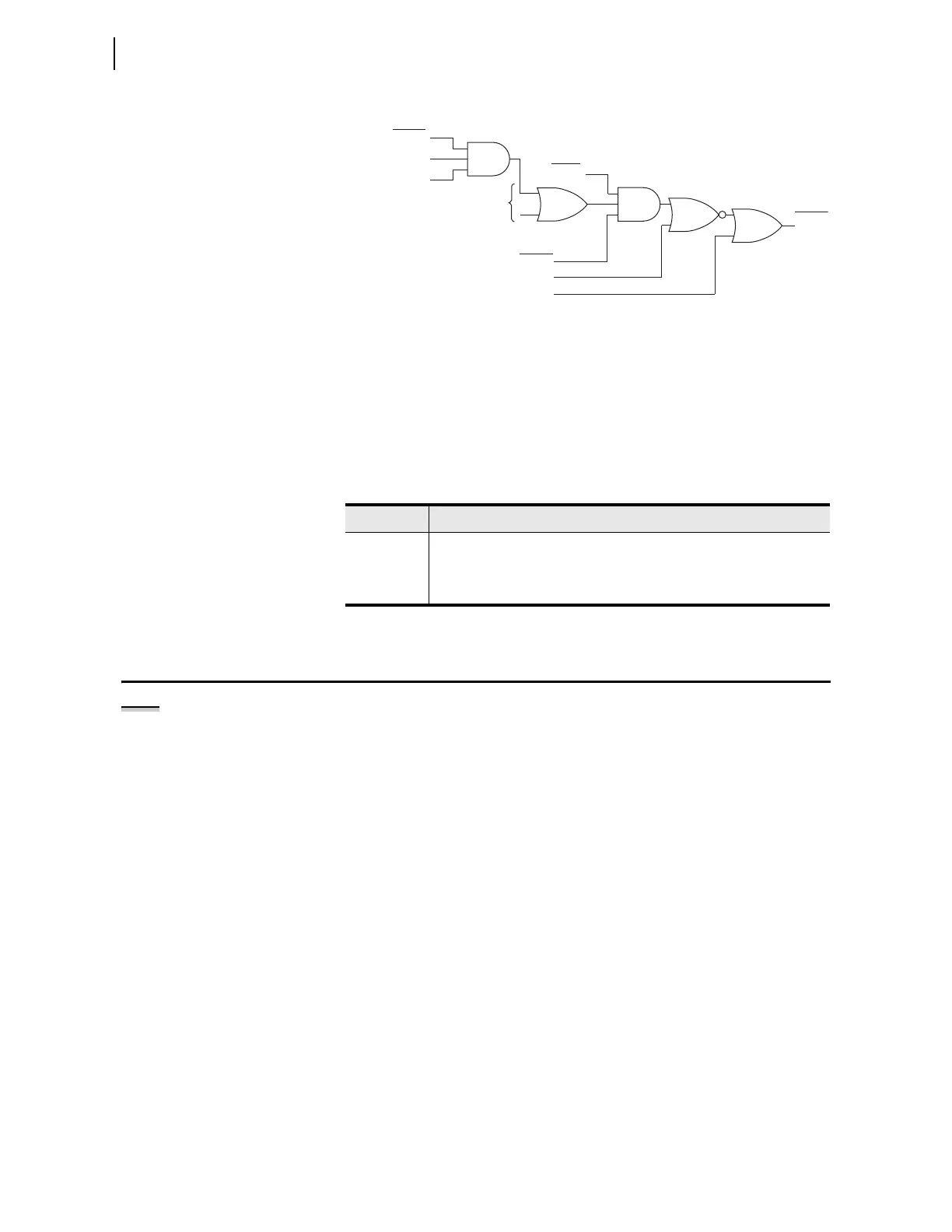
Figure 3.216 87L Lost (87LST) Logic
Use the three Relay Word bits to design your required backup logic for the
87L protection.
Note that 87MTR, 87SLV, and 87LST are not mutually exclusive. For
example, the 87L function can be a master (87MTR = 1), but it is incapable of
tripping (87LST = 1) when blocked. Or, the 87L function can be an outstation
(87SLV = 1) but be incapable of tripping (87LST = 1) because the relay to
which it connects is not a master.
87L Communications Report
The relay provides the 87L communications report to display and summarize
basic 87L configuration as well as real-time and historical channel monitoring
and alarming values.
The report covers the following three major areas.
➤ 87L configuration and overall status (examples: relay
identification, number of terminals in the 87L scheme, master
or outstation mode, channel problems, stub bus condition, test
condition, etc.).
➤ Detailed channel configuration, diagnostics, and health on a
per-channel basis (remote relay address, data synchronization
method and status, specific channel alarms, etc.).
➤ Long-term channel characteristics on a per-channel basis
(channel delay histogram, worst-case channel delay, etc.).
Figure 3.217 depicts the report layout. The report refers to general data items
as (a), (b), etc. Table 3.164 explains these data items in detail. Throughout this
section, the variable p refers to the channel number (p = 1, 2, 3). The report
displays data items related to all active channels (those for which the
87CHpAC Relay Word bit is asserted).
Table 3.163 87L Status Relay Word Bits
Name Description
87MTR 87L function is in the master mode
87SLV 87L function is in the outstation mode
87LST 87L function is lost (incapable of tripping from current or 87DTT)
Relay
Word Bits
Relay
Word Bit
87CHpAC
MASTER
87CHpOK
Relay
Word Bits
87SLV
87MTR
87LST
(all active channels) ...
(received
on the p-th
channel)
87BLK
E87DTT = 1
Setting
NOTE: To ensure proper
communication and protection,
please refer to the firmware
compatibility in Table A.2.


 To Next Page