P.3.268
SEL-411L Relay Protection Manual Date Code 20151029
Protection Functions
87L Communication and Timing
The relay is available with two options that are based on the IEEE C37.94
interface. The first uses the interface as defined by the IEEE standard, i.e., ST
connector, 850 nm wavelength, and 50 or 62 m multimode fiber. The second
uses the data structure and encoding defined by C37.94, as well as ST
connectors, but uses a 1300 nm wavelength, and 9 m single-mode fiber.
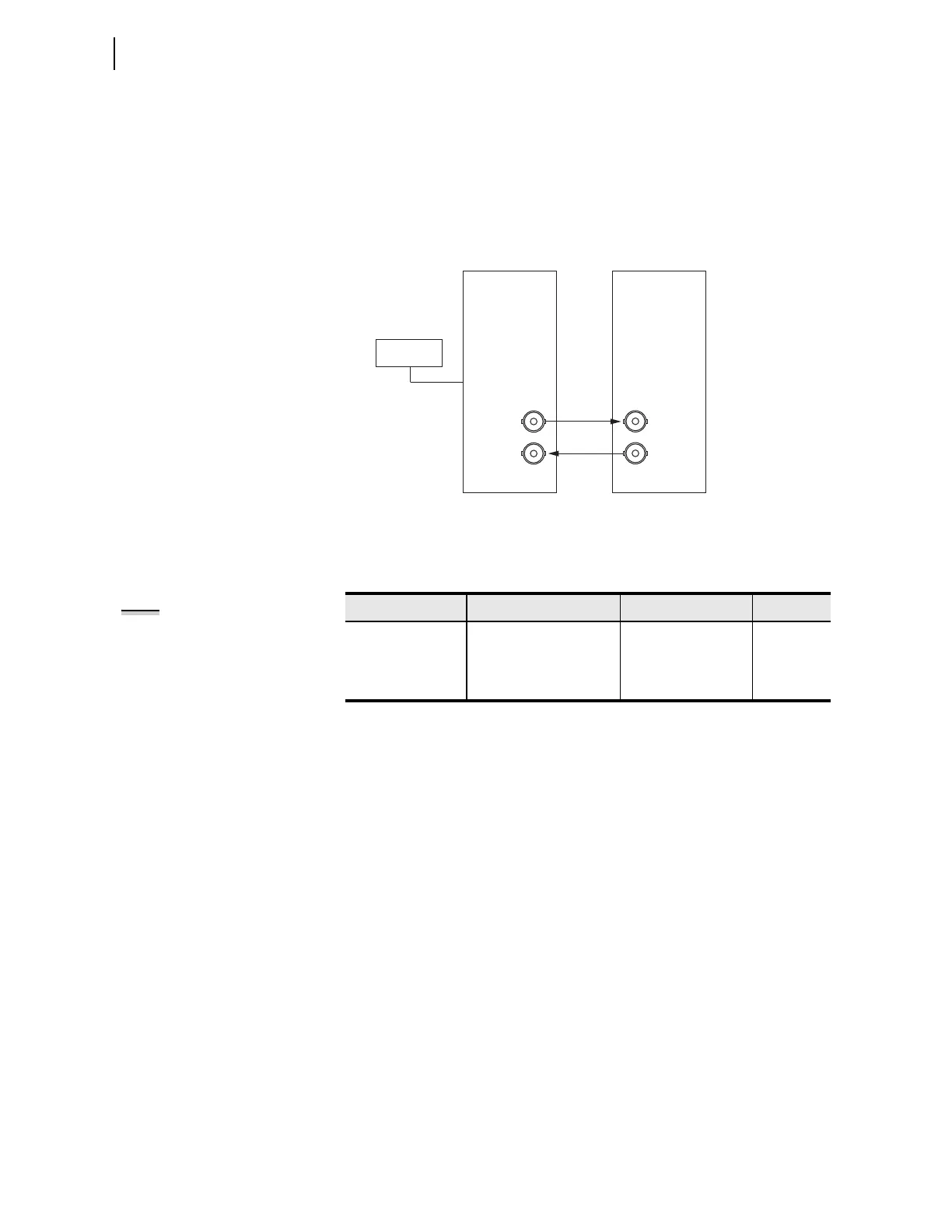
Connect the relay to a C37.94-compliant multiplexer as shown in
Figure 3.183.
Figure 3.183 is an example of a typical C37.94, 850/1300 nm connection.
Figure 3.183 C37.94, 850/1300 nm Typical Connection
Timing Source Settings
Make settings 87TIMC1 and/or 87TIMC2 = E at both line terminals to
synchronize the transmit data rate to exactly match the receive data rate set by
the multiplexer. C37.94 defines several troubleshooting aids, including a
Yellow Alarm bit. At present, the relay does not report the status of the receive
Yellow Alarm bit, nor does it generate a Yellow Alarm bit. Consult the
documentation provided with your multiplexer to determine when and if the
multiplexer asserts the Yellow Alarm indicators.
Back-to-Back Connections
For back-to-back connections, set the timing source setting to E in one relay,
and I in the other relay. The relay with its timing source set to E synchronizes
to the relay with setting equal to I, providing error free operation. The IEEE
C37.94 interface is suitable for distances up to 2 km (850 nm multimode fiber)
or 15 km (1300 nm single-mode fiber) either between the relay and the
multiplexer or directly between relays. For longer haul direct fiber
applications using multimode or single-mode fiber, order the 1300 nm or 1500
nm fiber-optic interfaces described next. Figure 3.184 shows an example of a
C37.94 back-to-back connection.
TX
Relay
CH1/2
ST-Connectors
RX
RX
MUX
TX
IRIG
(e.g., SEL-2407)
Required if
87CH1SN or
87CH2SN = T
Table 3.139 Timing Source Settings
Setting Description Range Default
87TIMC1 Channel 1 timing source I (internal)
E(external)
I
87TIMC2 Channel 2 timing source I (internal)
E(external)
I
NOTE: The 87TIMC1 and 87TIMC2
settings are hidden if the installed
communication card does not
support the C37.94 protocol.


 To Next Page