Page F-8
Appendix F – Network Topology
INTER-TEL
®
AXXESS
®
MANUAL VERSION 11.0 – May 2008
Private (Trusted) Networks
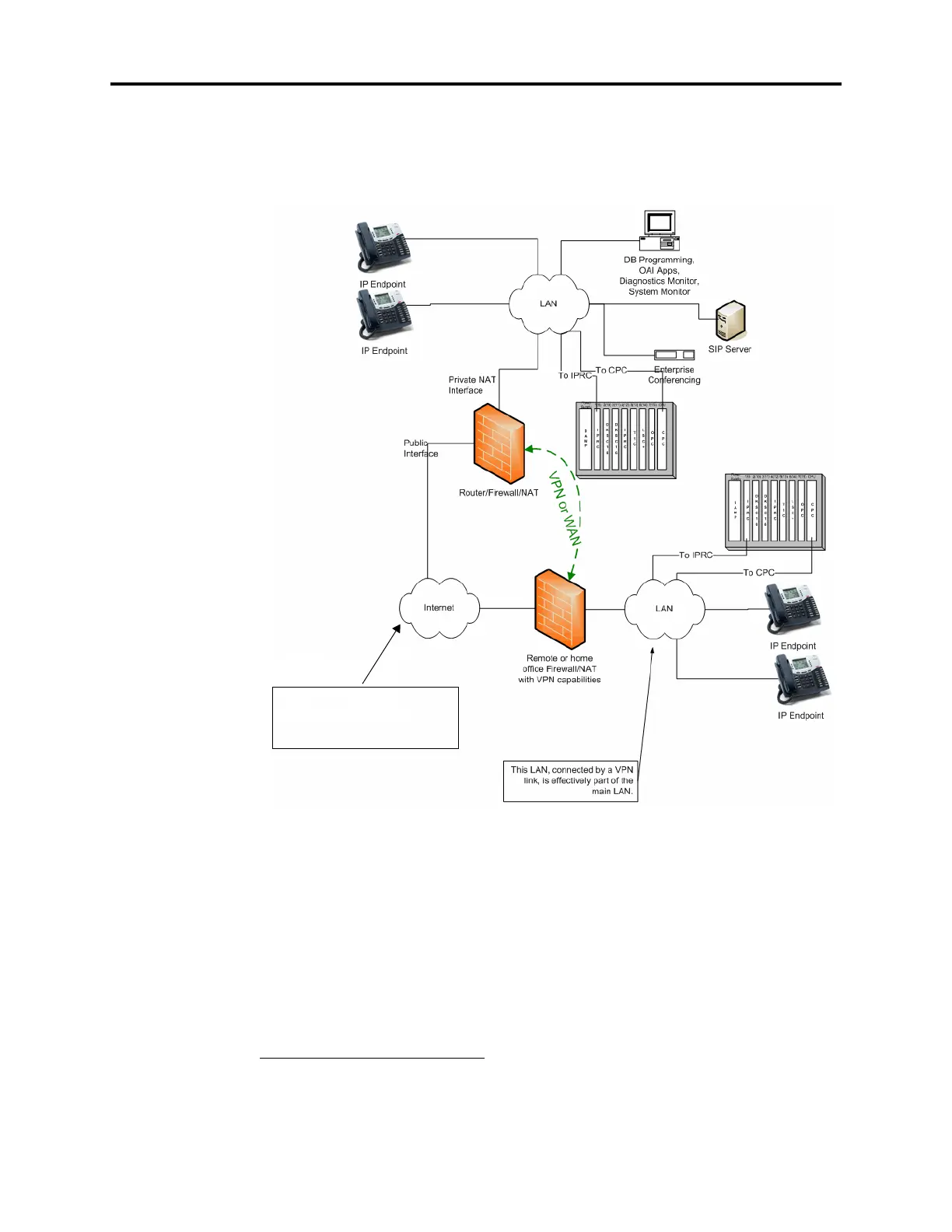
7.2 A Wide Area Network (WAN) provides the ability to connect two or more networks
without necessarily passing through a firewall/NAT. It essentially makes one larger private net-
work. A Virtual Private Network (VPN) uses public network facilities to provide private WAN
connections. In either implementation, there are no restrictions on topology as long as all IP
devices are on the same private network as shown below.
7.3 To allow IP endpoints on the Internet in the private networking scenario described
above, you may want to consider the following options:
• Configure a static NAT assignment in the near-end NAT. Program the Axxess system to
know IPRC’s NATed address along with which endpoints are connecting from the Inter-
net. See “Configuring Near-End NAT Traversal for IP Endpoints” on page F-14.
• Add an IPRC that connects outside the firewall (NAT). See “Using a Second IPRC to
“Straddle” the Firewall (NAT)” on page F-13 for more information.
• Provide VPN connectivity
4
between the private network and the network containing the
IP endpoint.
• Network an additional Axxess or Inter-Tel 5000 system using PRI networking, and
place it in a non-NATed DMZ as described below.
4. Although VPN links avoid the security and NAT addressing issues, the encryption of VPN traffic
sometimes introduces significant delays making it unsuitable for VoIP communications. This is a
function of the network connections and the networking equipment.
Note that IP endpoints and Inter-
Tel Private Networking will work
outside the firewall with near-end
NAT traversal.



 To Next Page