Page 5-153
System Features
INTER-TEL
®
AXXESS
®
MANUAL VERSION 11.0 – May 2008
Mini-DSS Units
FEATURES
5
12.124In DB Programming, DSS/BLF buttons may also be programmed for direct access to
other resources (such as paging zones), or they can be assigned feature codes. Busy lamp indi-
cation is provided to show the idle/busy status of the resource or feature. Note that program-
ming a DSS/BLF button as a resource does not always provide a transfer capability. For
example, a DSS button programmed for paging will not transfer a party to the paging system.
M. MINI-DSS UNITS
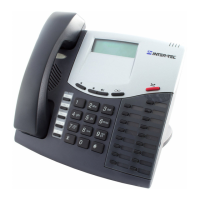
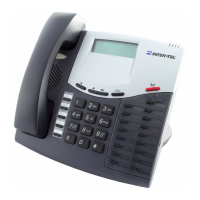
12.125Version 7.0 and later software supports a Mini-DSS that has 16 user-programmable
buttons. This unit attaches directly to the Model 8520 or 8560 Phone and does not require a
PCDPM or AC transformer. Like the DSS/BLF Unit, these buttons contain lamps that light or
flash depending on the status of a station or the button’s programming. For details about the
lamps, see the previous section.
NOTE: Version 7.0 or later software is required to use the Mini-DSS.
N. DESKTOP OAI, DSS UNITS, AND RS232
12.126The desktop interface (DTI) protocol allows stations using a DTI connection to monitor
different groups of system devices. Because this monitoring consumes system resources, there
is a limit on the total number of devices that users can monitor with RS232 connections. (This
does not apply to socket connections, which are virtually limitless.)
NOTE: One virtual DSS unit supports 60 devices. For example, to monitor all 300 hunt groups
in a v7.0 or later system, you would need 5 DSS units (300/60 = 5).
12.127Although the total number of virtual DSS units available (150) has not increased as of
version 6.0, the number of devices has, resulting in a limited number of stations that can moni-
tor all devices simultaneously. To compensate for the increased number of devices, versions
6.0 and later use a DTI monitor limiter scheme that bases each station’s resource usage on the
actual number of devices the station is monitoring. Any unused virtual DSS units are then
available for use by other stations. For example, if a station is monitoring 120 hunt groups
(instead of all 300), the remaining 3 DSS units become available for other stations, which
increases the number of stations that can enable monitoring.
Table 5-32. DSS/BLF Button Indications
Indication Meaning
Solidly Lit The associated resource is busy or all stations in the associated hunt group
are unavailable (in do-not-disturb, busy, or with hunt group remove enabled).
Or, the associated feature is on.
Slow Flash The station is in do-not-disturb.
Fast Flash The station has a call ringing in or a call is camped on to the hunt group.
(This option is programmable. If DSS ring flash is disabled, a call ringing in
to a station will show a solidly lit LED.)
Continuous
Flutter
The station is causing a STATION OFF-HOOK system alarm.


 To Next Page