Page 5-27
System Features
INTER-TEL
®
AXXESS
®
MANUAL VERSION 11.0 – May 2008
Attendant Stations
FEATURES
5
6. ATTENDANT STATIONS
NOTE: For information on automated attendants, see page 4-16 in VOICE PROCESSING
FEATURES.
6.1 Attendant stations can be called by dialing 0 at the stations they serve. Usually, they are
also programmed to provide these services:
• Central operators for incoming calls
• Message centers
• Recall stations for unanswered calls
6.2 Any station can be designated as an attendant station during DB Programming (see
page 6-209 in PROGRAMMING). Attendant stations should be equipped with display phones
to show recall sources.
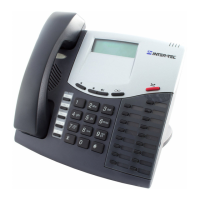
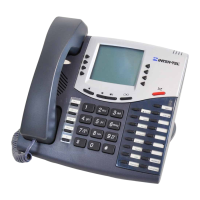
6.3 If using an Executive Display, Professional Display, Standard Display, Associate Dis-
play, Model 8520, or Model 8560 Phone, an attendant’s station can also be used with a PC
Data Port Module (PCDPM) and single or tandem DSS/BLF Units for one-button intercom
dialing of extension numbers and for constant station/hunt group status indications. (Non-
attendant Executive Display, Professional Display, Standard Display, Associate Display, Model
8520, or Model 8560 Phones can also be equipped with DSS/BLF Units.) Up to 20 DSS/BLF
units can be equipped per system, up to four per Executive Display, Professional Display, Stan-
dard Display, Associate Display, Model 8520, or Model 8560 Phone (see page 5-152).
NOTE: Model 8520 and 8560 Phones also support the Mini-DSS, which provides 16 user-pro-
grammable buttons. The Mini-DSS does not affect the number of DSS/BLF Units that can attach
to the phone.
6.4 A hunt group can be assigned to serve as an attendant. However, the individual stations
in the hunt group are not required to be programmed as attendant stations, and the database
does not reflect that the individual stations serve as an attendant for any other stations. (This
feature is especially useful when a voice mail hunt group is assigned as an attendant.)
A. NETWORK AND LOCAL PRIMARY ATTENDANTS
6.5 One attendant can be designated as the primary attendant who can receive unsupervised
outside call recalls, hunt group recalls, and calls that cannot be matched to patterns in call rout-
ing tables. (See page 6-319 in PROGRAMMING for more information.)
6.6 When phone systems are installed in a network, there are two types of primary atten-
dants:
• Node Attendants: There can be a primary attendant for each node.
• Network Primary Attendant: There can be a network primary attendant programmed
on each node. (There is usually one Network Primary Attendant shared by all of the
nodes.) When the network needs to direct a call to an attendant, it attempts to direct the
call to the network primary attendant first. If the network primary attendant is unavail-
able, it directs the call to the attendant on the node where the call originated.


 To Next Page