Page 5-190
System Features
INTER-TEL
®
AXXESS
®
MANUAL VERSION 11.0 – May 2008
Off-Hook Voice Announce (OHVA)
25. OFF-HOOK VOICE ANNOUNCE (OHVA)
25.1 The Off-Hook Voice Announce (OHVA) feature allows an intercom caller (either sin-
gle-line or phone) to establish voice contact with the called phone user, even though the user
already has a call in progress on the handset. The called phone user can then talk freely on both
connections, using the handset for the original call and the speakerphone for the OHVA inter-
com call. Note that the caller on the handset call will be able to hear the OHVA call.
25.2 In an Inter-Tel system network, intercom callers can establish OHVA calls to phones on
other nodes.
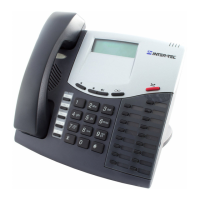
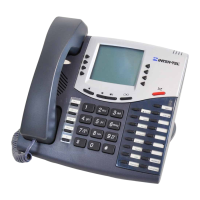
25.3 A PC Data Port Module (PCDPM) must be installed on Executive Display, Professional
Display, Standard Display, Associate Display, Model 8520, or Model 8560 Phones to provide
the secondary voice path needed for the OHVA feature.
25.4 To enable the OHVA, the following must be completed:
• The OHVA system flag must be enabled. (When the system is in the default state, this
flag is enabled.)
• Each OHVA-ready phone can be programmed for placing and/or receiving OHVA calls.
(By default, OHVA is disabled at the station level.)
• Other phone and single-line stations can be programmed for placing OHVA calls, as
desired. Phones without PC Data Port Modules or secondary voice paths and single-line
sets cannot receive OHVA calls since they do not have secondary voice path circuitry.
(By default, OHVA is disabled at the station level.)
• DSS/BLF-equipped phones can be programmed to override the Camp-On and OHVA
Screening timers and make “immediate” OHVA calls. This is a useful option for atten-
dant stations.
25.5 Any combination of OHVA-enabled and -disabled stations is available through DB Pro-
gramming. For example, all attendants may be programmed to make, but not receive, OHVA
calls, while other stations are allowed to receive, but not place, OHVA calls.
25.6 OHVA calls cannot be processed if the secondary voice path or the speakerphone of the
called phone is not available. This occurs when the phone has a different OHVA call in
progress, has an active data call in progress, is on an active handsfree intercom or outside call,
has handsfree disabled, has a call being changed from handset to speakerphone, has a headset
enabled, or is in do-not-disturb. Also, OHVA calls are not possible if the caller is placing a pri-
vate intercom call or has the Ring Intercom Always feature enabled.
NOTE: To place an OHVA call using a single-line phone, the Ring Intercom Always feature
must be disabled. To disable this feature, lift the handset and dial 377 (Ring Intercom Always
ON/OFF feature code) on the single-line phone. By default, this is enabled.


 To Next Page