Installation
INTER-TEL
®
AXXESS
®
MANUAL VERSION 11.0 – May 2008
Page
3-136
Point-to-Point and Point-to-Multipoint
Point-to-Point and Point-to-Multipoint
10.61 The system supports point-to-point and point-to-multipoint (BRS trunk side only).
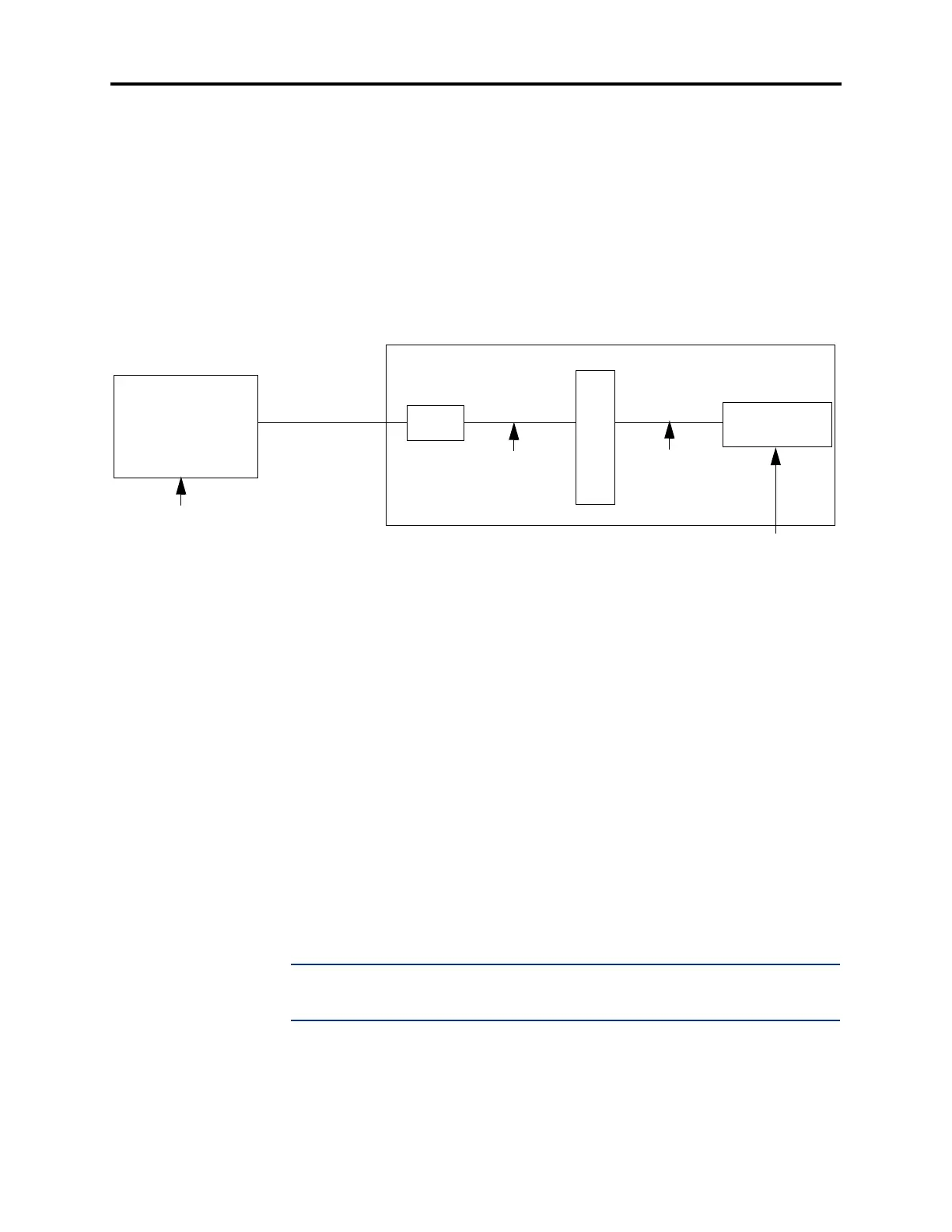
• Point-to-Point Setup: (Supported) This is a configuration of a single BRI ISDN circuit
provided by the ISDN Provider to an ISDN device. One terminal or user system is con-
nected through the S Interface (4-Wire) to the network termination (NT1). The length of
the bus is limited to 3333 ft (1 km) of cable with a maximum cable attenuation of 6 dB
at 96 kHz. In a point-to-point scenario only a single TEI value of ZERO is used as the
connection is assumed always on. See below for an example of a Point-to-Point setup.
Figure 3-69. Example of a Point-to-Point Setup Using a BRS Card
• Point-to-Multipoint Setup (Passive Bus): (Supported on BRS Trunk Side only) The
Point-to-Multipoint setup allows multiple connections from the NT1 to multiple ISDN
devices. In other words, one or more ISDN devices (up to eight devices) can share a
single BRI ISDN circuit. This type of configuration is called passive bus configuration.
Each ISDN device on a multiple point configuration has a unique TEI number so it can
be identified. The passive Bus setup is more than one ISDN device connected through
the S (S/T) interface (4-wire) to the same network termination (NT1), sharing the
access to the two B-channels and to the D-channel. But only two terminals can com-
municate simultaneously on the two B-channels in this application.
Using the Inter-Tel
BRS trunk port, it connects to the S (S/T) interface with other ISDN devices.
The length of the passive bus is limited to 667 ft (200 m) of cable in a short passive bus
configuration, or to 3333 ft (1 km) of cable in an extended passive bus configuration. In
an extended passive bus configuration, the terminals must be clustered in the last 83 to
167 feet (25 to 50 meters) of the bus. In a point-to-multipoint (PMP) scenario multiple
auto assigned TEI values are used to communicate with the devices. The devices them-
selves are generally on most PBXs. They are programmed only to respond to their
extension numbers when they see the numbers in the subaddress field in the setup mes-
sage broadcast down the bus. See Figure 3-70 on the following page for an example of
a Point-to-Multipoint Setup.
NOTE: The Passive bus configuration is only supported on the Inter-Tel system with
the BRS card programmed as a Trunk port. The Passive bus setup is not supported on
BRS station port.
U Interface
BRS CARD
NT1
ISDN DEVICE
T Interface S Interface
LOCAL
OR
ISDN PROVIDER
CUSTOMER LOCATION
TEI setting on
the video unit
must be set to
VIDEO UNIT
Station/Station
port on the BRS
with the TEI set
to Automatic.
Trunk/Trunk port on the BRS
with the TEI set to Automatic
(default setting). It may
require a change to the set-
ting to “Fixed 0.”
The TEI setting from the
ISDN provider is set to
SERVICE POINT
EXCHANGE


 To Next Page