Page 5-32
System Features
INTER-TEL
®
AXXESS
®
MANUAL VERSION 11.0 – May 2008
Hunt Groups
9. HUNT GROUPS
9.1 The Hunt Group feature permits calls to be placed to a group of stations and to be auto-
matically transferred to an available station within the group. Up to 75 hunt groups (300 with a
CP Server) can be programmed in the database. Hunt group lists can contain individual stations
and/or extension lists. Non-ACD hunt group stations must reside on the same node; off-node
devices must be ACD hunt group members.
9.2 The order in which hunt group stations receive incoming calls is determined by a list
stored in the database. A station or extension list can appear in a single hunt group more than
once, and it can appear in multiple hunt group lists, if desired.
9.3 Hunt groups have their own extension numbers (defaults to 2000-2074 or 2000-2299).
Individual stations within the hunt group can be called using their assigned extension numbers.
9.4 Two other premium feature hunt group types are also available: UCD Hunt Groups and
ACD Hunt Groups. For UCD information, see page 5-37. For ACD, see page 5-44.
A. HUNT GROUP CALL DISTRIBUTION
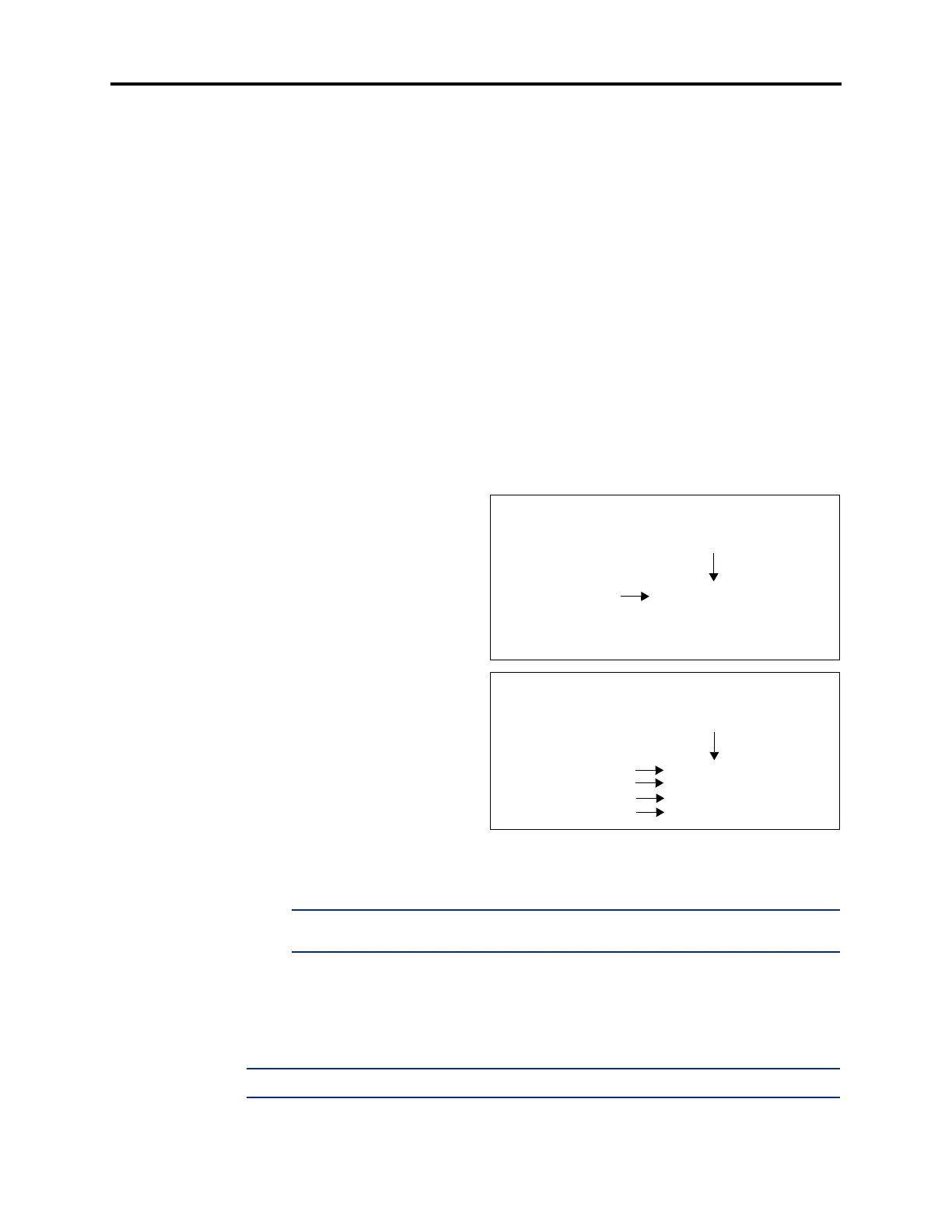
9.5 When an intercom or outside call is transferred or rings in to the pilot number, it circu-
lates through the hunt group in linear or distributed order until answered, as described below.
• Linear order: Incoming calls
always start circulating by
ringing at the first station (or
extension list) on the hunt
group list that is stored in the
database.
• Distributed order: To even
out the call load, distributed
order shifts the starting point
of each call. When a station
user receives a call, the next
station or extension list in the
hunt group receives the next
incoming call. If the receiv-
ing station is busy (or all sta-
tions in the extension list are busy), or if there is no answer before the No Answer
Advance timer expires, the call goes to the next station or extension list on the hunt
group list.
NOTE: See page 5-44 for information on the additional distribution types available in
ACD hunt groups.
9.6 If an extension list is included in a hunt group, a call rings all stations on the extension
list when it reaches that point in the hunt group list. Therefore, to create an “all ring” type of
hunt group, you can program the hunt group as either linear or distributed and then assign an
extension list as the only hunt group member.
NOTE: A CP Server is required to support off-node members of an all-ring hunt group.
LINEAR HUNT GROUP CALL PROCESSING
Hunt group pilot
number 2000 called
Calls will always
begin search here
HUNT GROUP MEMBERS:
EXT. 1000
EXT. 1001
EXT. 1002
EXT. 1003
DISTRIBUTED HUNT GROUP CALL PROCESSING
Hunt group pilot
number 2000 called
EXT. 1000
EXT. 1001
EXT. 1002
EXT. 1003
1st call begins here
2nd call begins here
3rd call begins here
4th call begins here


 To Next Page