Page 1-7
Overview
INTER-TEL
®
AXXESS
®
MANUAL VERSION 11.0 – May 2008
System Capacities
OVERVIEW
1
7.3 Voice mail service can be provided using either the Voice Processing Unit, an Enter-
prise
®
Messaging system, or the Embedded Voice Mail Card (EVMC). The EVMC is recom-
mended only for single-chassis systems. For more details about the EVMC see page 2-69. For
information about the CPU64 configuration, which uses the EVMC, see Appendix D —
CPC64/CPU64 Configuration. For information about Enterprise Messaging system, see the
Enterprise Messaging Manual (document part no. 780.8006).
7.4 In addition to certain resources provided by the system’s main processing cards, the
1792 ports can be used to equip a variety of trunks and station instruments, including:
• Central Office —CO Trunks [Local Exchange Trunks in Europe]: Loop start and/or
ground start trunks, installed in increments of up to four or eight, depending on the
number of trunk circuit cards installed in the equipment chassis.
• T1 (E1) Trunks: Loop start, ground start, DID [DDI in Europe], E&M (U.S. only),
and/or OPX trunks installed in increments of up to 24, depending on the number of T1,
E1/PRI, or T1/E1/PRI cards installed in the equipment chassis.
• Primary Rate Interface (PRI) Trunks: ISDN PRI trunks installed in increments of up
to 24 (23 bearer channels and one data channel) [or 30 in Europe], depending on the
number of PRI-equipped T1 or E1 cards in the chassis.
• Basic Rate Interface (BRI) Trunks: ISDN BRI trunks installed in up to 2 bearer chan-
nels on BRS or BRU (U.S. only) cards in the chassis.
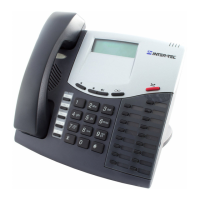
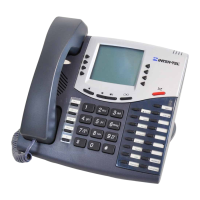
• Digital Phones: Axxess
Basic, Eclipse™ Basic, Standard Display, Associate Display,
Professional Display, Executive Display, Model 8500, Model 8520, and Model 8560
Phones in increments of up to eight or 16, depending on the number of Digital Keyset
Cards (DKSCs) and 16-Port Digital Keyset Cards (DKSC-16s or DKSC-16+s) installed
in the chassis.
NOTE: The Professional Display, Associate Display, and Eclipse Basic Digital Phones
are supported by U.S. software only.
• IP Devices: A combination of up to eight IP PhonePlus, Model 8660 Phone, or IP SLA
ports to provide voice-over-IP functionality on Inter-Tel phone systems. The v1.x firm-
ware device Internet Protocol Resource Card (IPRC) supports a combination of up to 16
IP PhonePlus, Model 8660 Phone, or IP SLA ports. This IPRC also supports up to 16 IP
trunks via media gateway control protocol (MGCP). The v8.x.x and 9.0.0 firmware
IPRC supports a combination of up to 32 IP Phone Plus, Model 8660 Phone, multi-pro-
tocol endpoint, Model 8602 IP softphone, IP SLA ports or up to 32 MGCP gateways/
endpoints. (The v8.x and 9.0.0 firmware IPRC does not support IP SoftPhones.) The
IPC uses a 10Base-T Ethernet interface to the stations and an RS-232 interface for diag-
nostics and programming. The IPRC uses a 100/10Base-T Ethernet interface to the sta-
tions and an RS232 interface for diagnostics and programming. For details, see the
latest IP Devices Manual (document part no. 835.2195).
NOTE: If licensed for networking, you cannot use the IPRC for devices. Make sure you
have the appropriate software license loaded before you program the IPRC.
• Multi-protocol Endpoints: Models 8600, 8620/8622, 8662, and 8690 support either
ITP (an Inter-Tel protocol) or Session Initiation Protocol (SIP). These endpoints require
a software license and must terminate at a version 8.1 or later firmware IPRC. They
cannot terminate at an IPC or a v1.x firmware device IPRC.


 To Next Page