Page 1-27
Overview
INTER-TEL
®
AXXESS
®
MANUAL VERSION 11.0 – May 2008
Phone Features
OVERVIEW
1
B. PHONE FEATURES
NOTE: For a complete listing of all the optional equipment that may be installed on each
phone, see the information in SPECIFICATIONS beginning on page 2-72.
• Various digital and analog phone models are available (for a complete listing of all the
phone models available, see page 2-72)
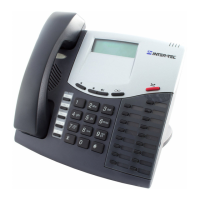
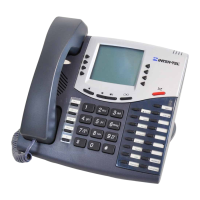
• Executive Display Phones, Professional Display Phones, Standard Display Phones,
Associate Display Phones, Axxess Basic Digital Phones, Eclipse Basic Digital Phones,
Model 8500 Phones, Model 8520 Phones, Model 8560 Phones, Executone
®
Phones,
IMX AIM phones, and Inter-Tel/DVK phones all allow the user to individually control
voice and tone volume levels for intercom calls, outside calls, background music, etc.
NOTE: The Professional Display, Associate Display, Eclipse Basic Digital, and Execu-
tone Phones are supported by U.S. software only.
•∗ Liquid crystal display (LCD) for viewing numbers dialed, speed-dial numbers, inter-
station, do-not-disturb, and reminder messages, date/time, phone identification, station
programming, user prompts; etc.
•∗ Optional Personal Computer Data Port Module (PCDPM) on Standard Display, Associ-
ate Display, Executive Display, Professional Display, Model 8520, or Model 8560
Phones for off-hook voice announce receive capability and for the installation of a
DSS/BLF Unit and/or an optional Modem Data Port Module (may also be used to con-
nect an output device or a programming PC)
•∗ Optional Modem Data Port Module (MDPM) on Standard Display, Executive Display,
Model 8520, or Model 8560 Phones for installing a modem-equipped data device (for
simultaneous voice/data communication) or a single-line set – requires a PCDPM
•∗ Optional Data Port Module on IMX or ESP 12-/24-line, Inter-Tel/DVK, and GMX 24-
line analog phones for installing a modem-equipped data device (for simultaneous
voice/data communication), or for installing a loud ringing adapter (LRA) and signal-
ing device(s)
• 12-button dialpad
• “Hot” keypad – allows dialing of feature codes, extension numbers, and trunk access
codes without pressing the Special button ( )
or lifting the handset
• Up to 250 keymaps for determining the exact layout and function of the buttons
• Feature buttons for one-button access to feature codes (some of the buttons may be des-
ignated as user-programmable)
• Speed-dial buttons with light-emitting diode (LED) indicators
• Call appearance buttons with LED indicators (for incoming call indication/access)
• Secondary extension appearance buttons with LED indicators (show call status indica-
tions for the designated “primary” station)
• Individual trunk buttons with LED indicators (for incoming and outgoing call indica-
tion/access)
• Trunk group buttons with LED indicators (for outgoing call access and trunk group sta-
tus)
• Speakerphone (allows handsfree operation on outside calls and intercom calls)


 To Next Page