Page 5-70
System Features
INTER-TEL
®
AXXESS
®
MANUAL VERSION 11.0 – May 2008
Direct Inward Dialing (DID) Trunks (U.S. Only)
G. DIRECT INWARD DIALING (DID) TRUNKS (U.S. ONLY)
10.57 Direct Inward Dialing is available on T1 or T1/E1 card circuits and Single-Line
Adapter (SLA) interfaces. (See page 2-39 in SPECIFICATIONS for more information.) E&M
trunks on T1 or T1/E1 cards can also be designated as DID trunks.
10.58 Direct inward dialing (DID) allows an outside party to dial into the system without
attendant intervention. To gain direct access to the system, an outside party dials a number that
was assigned by the telephone company to the DID trunks installed on the phone system. The
system then provides ring signal to the proper station(s), hunt group, or DISA according to the
programmed ring-in for that DID number.
10.59 DID trunks are purchased with blocks of numbers. When a caller dials one of the num-
bers, the central office rings the trunk that contains that number. When the system answers the
call, it handshakes with the central office and receives digits that tell it which DID number was
dialed. The system then routes the call according to the call routing programmed for that num-
ber.
10.60 When a call is placed to a DID trunk, one of three things happens:
• If the receiving DID trunk is programmed for “Immediate” start type, it immediately
begins receiving the dialed digits to the receiving system.
• If programmed for “Wink” start type, the DID trunk performs a “handshake” to signal
that it is ready to receive the incoming digits. (This is the default start type.)
• If programmed for “Delay Dial” start type, the DID trunk performs a handshake and
pause before receiving any digits.
10.61 Each DID trunk is programmed with a base number and is programmed to collect a set
number of digits. The base number is made up of the digits that are dialed by the caller that are
not redialed by the central office after the handshake. For example, if the dialed number is 961-
9000 and the base number is 9619, the central office would send only 000 after the handshake.
The system would then send the call to the ring-in destination associated with 000 in the
trunk’s call routing table. The number sent to the phone display could combine the base num-
ber and the collected digits to show 961-9000 or can be programmed to show a name. (See
page 5-13 for a description of the Display Outside Party Name On/Off feature code.)
10.62 DID trunks are programmed into trunk groups. However, because DID trunks do not
allow outgoing calls to be placed, the outgoing access programming for the trunk group is
ignored. If a user attempts to seize a DID trunk for an outgoing call, the user hears reorder
tones and the phone display shows OUTGOING ACCESS DENIED.
10.63 The DID/E&M [DDI in
Europe] Receive Busy Instead Of
Camp-On station flag determines
whether E&M and DID callers
receive busy signal or receive ring-
back and camp on when calling a
busy station. In the default state,
busy tones are disabled and the call-
ers hear ringback while camped on to
the called station. This flag is pro-
grammed on a station-by-station
basis (see page 6-210 in PRO-
GRAMMING).
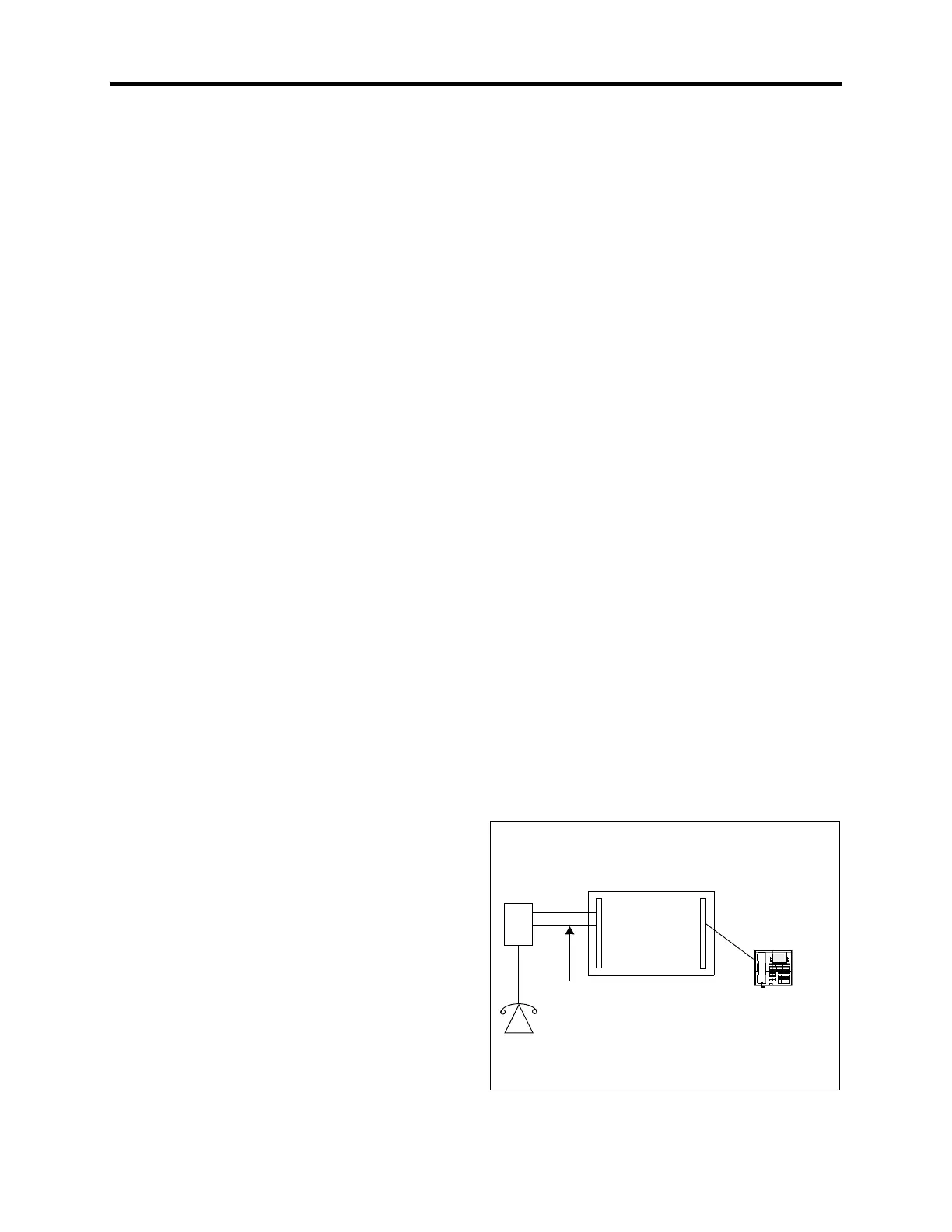
DID TRUNKS
Customer has purchased a DID trunk using the base digits
555, but may have many numbers assigned to the trunk.
DISPLAY:
555-0444
RINGING IN
CALL
ROUTING
TABLE
0444 = Ext. 1222
CO
Ext. 1222
DID TRUNKS: DID digits
0444 sent to system
INCOMING CALL:
Caller dialed
555-0444


 To Next Page