SYSCLK3
DIV4P5CLK
PLL Controller
0
1
CFGCHIP3[EMA_CLKSRC]
LPSC
EMIFA
www.ti.com
Peripheral Clocking
111
SPRUH91D–March 2013–Revised September 2016
Submit Documentation Feedback
Copyright © 2013–2016, Texas Instruments Incorporated
Device Clocking
6.3.3 EMIFA Clocking
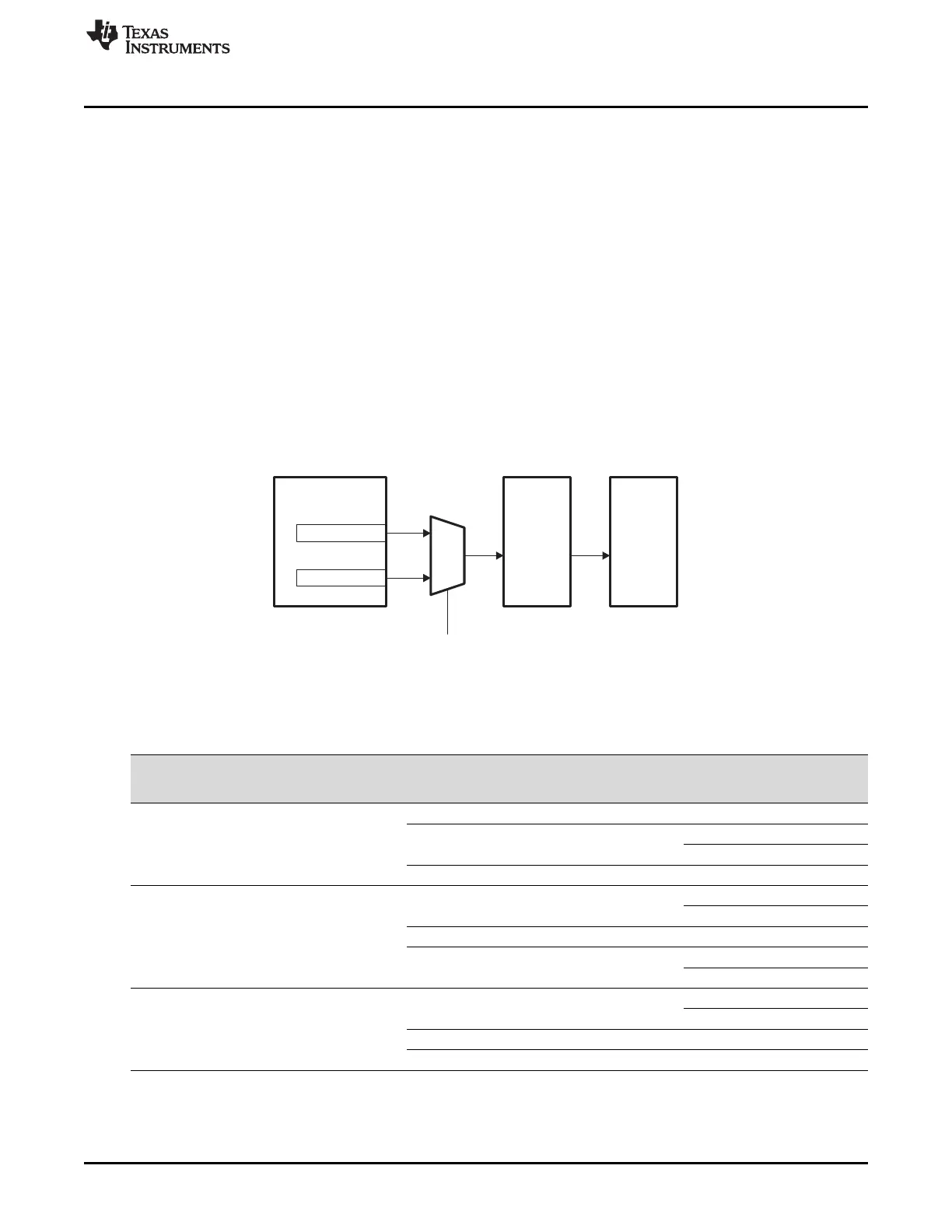
EMIFA requires a single input clock source. The EMIFA clock can be sourced from either SYSCLK3 or
DIV4P5 (see Figure 6-4). The EMA_CLKSRC bit in the chip configuration 3 register (CFGCHIP3) of the
System Configuration Module controls whether SYSCLK3 or DIV4P5 is selected as the clock source for
EMIFA.
Selecting the appropriate clock source for EMIFA is determined by the desired clock rate. Table 6-6 shows
example PLL register settings and the resulting DIV4P5 and SYSCLK3 frequencies based on the OSCIN
reference clock frequency of 25 MHz. From these example configurations, the following observations can
be made:
• To achieve a typical frequency of 100 MHz supported by EMIFA and the typical CPU frequency of 300
MHz, the output of the PLL multiplier should be set to 600 MHz and the EMA_CLK source should be
set to SYSCLK3 with the PLLDIV3 register set to 3.
• The frequency of the DIV4P5 clock is fixed at the output frequency of the PLL multiplier block divided
by 4.5.
• The PLLDIV3 block that sets the divider ratio for SYSCLK3 can be changed to achieve various clock
frequencies.
Figure 6-4. EMIFA Clocking Diagram
(1)
See Section 6.2 for explanation of POSTDIV divider modes.
Table 6-6. EMIFA Frequencies
OSCIN
Frequency
PLL Multiplier
Register
Setting
Multiplier
Frequency
(MHz)
Post Divider
Mode
(1)
POSTDIV
Output
Frequency DIV4P5
PLLDIV3
Register
Setting SYSCLK3
25 24 600 Div2 300 MHz 133 MHz 2 100 MHz
Div3 200 MHz 133 MHz 2 66.6 MHz
1 100 MHz
Div4 150 MHz 133 MHz 1 75 MHz
25 18 450 Div2 225 MHz 100 MHz 3 56.3 MHz
2 75 MHz
Div3 150 MHz 100 MHz 1 75 MHz
Div4 112.5 MHz 100 MHz 1 56.3 MHz
0 112.5 MHz
25 16 400 Div2 200 MHz 89 MHz 2 66.6 MHz
1 100 MHz
Div3 133 MHz 89 MHz 1 66.5 MHz
Div4 100 MHz 89 MHz 0 100 MHz



 To Next Page