A_1022 A_1023 A_1024
B_1023B_1022 B_1024
D_1023
C_1023
D_1022
C_1022
D_1024
C_1024
...
...
... ...
...
...
...
...
D_2D_1 D_3
C_2
B_2
A_2
C_1
B_1
A_1
B_3
C_3
A_3
4000 0000h D_1
D_2
D_1023
...
D_3
...
D_1022
D_1024
B_1 C_1A_1
B_2 C_2A_2
C_1023B_1023
A_1023
...
...
...
B_3 C_3A_3
...
...
...
C_1022B_1022A_1022
B_1024 C_1024A_1024
1180 0000h
Transfer Examples
www.ti.com
486
SPRUH91D–March 2013–Revised September 2016
Submit Documentation Feedback
Copyright © 2013–2016, Texas Instruments Incorporated
Enhanced Direct Memory Access (EDMA3) Controller
16.3.3 Data Sorting Example
Many applications require the use of multiple data arrays; it is often desirable to have the arrays arranged
such that the first elements of each array are adjacent, the second elements are adjacent, and so on.
Often this is not how the data is presented to the device. Either data is transferred via a peripheral with
the data arrays arriving one after the other or the arrays are located in memory with each array occupying
a portion of contiguous memory spaces. For these instances, the EDMA3 can reorganize the data into the
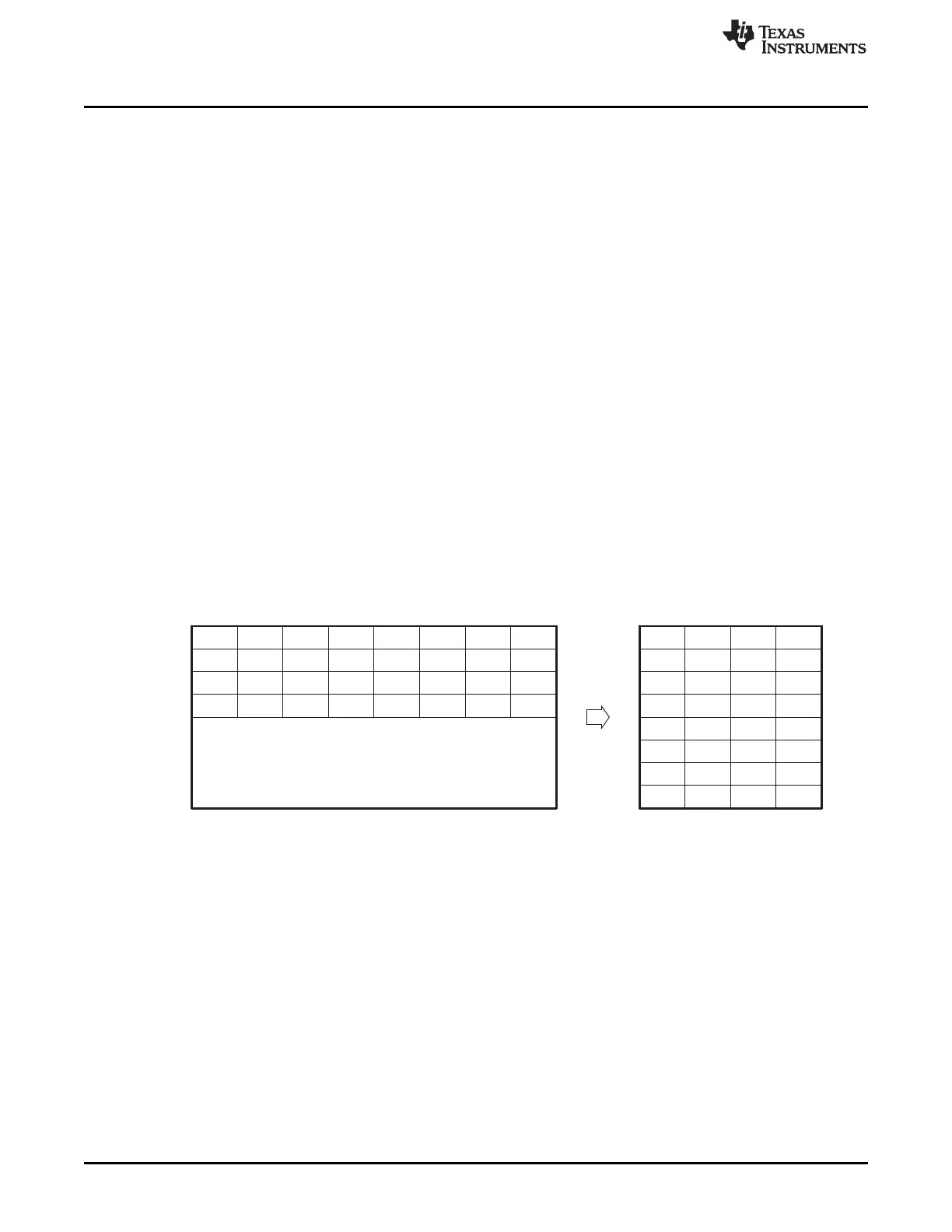
desired format. Figure 16-19 shows the data sorting.
In order to determine the parameter entry values, the following need to be considered:
• ACNT – Program this to be the size in bytes of an array.
• BCNT – Program this to be the number of arrays in a frame.
• CCNT – Program this to be the number of frames.
• SRCBIDX – Program this to be the size of the array or ACNT.
• DSTBIDX = CCNT × ACNT
• SRCCIDX = ACNT × BCNT
• DSTCIDX = ACNT
The synchronization type needs to be AB-synchronized and the STATIC bit is 0 to allow updates to the
parameter set. It is advised to use normal DMA channels for sorting.
It is not possible to sort this with a single trigger event. Instead, the channel can be programmed to be
chained to itself. After BCNT arrays get sorted, intermediate chaining could be used to trigger the channel
again causing the transfer of the next BCNT arrays and so on. Figure 16-20 shows the parameter set
programming for this transfer, assuming channel 0 and an array size of 4 bytes.
Figure 16-19. Data Sorting Example



 To Next Page