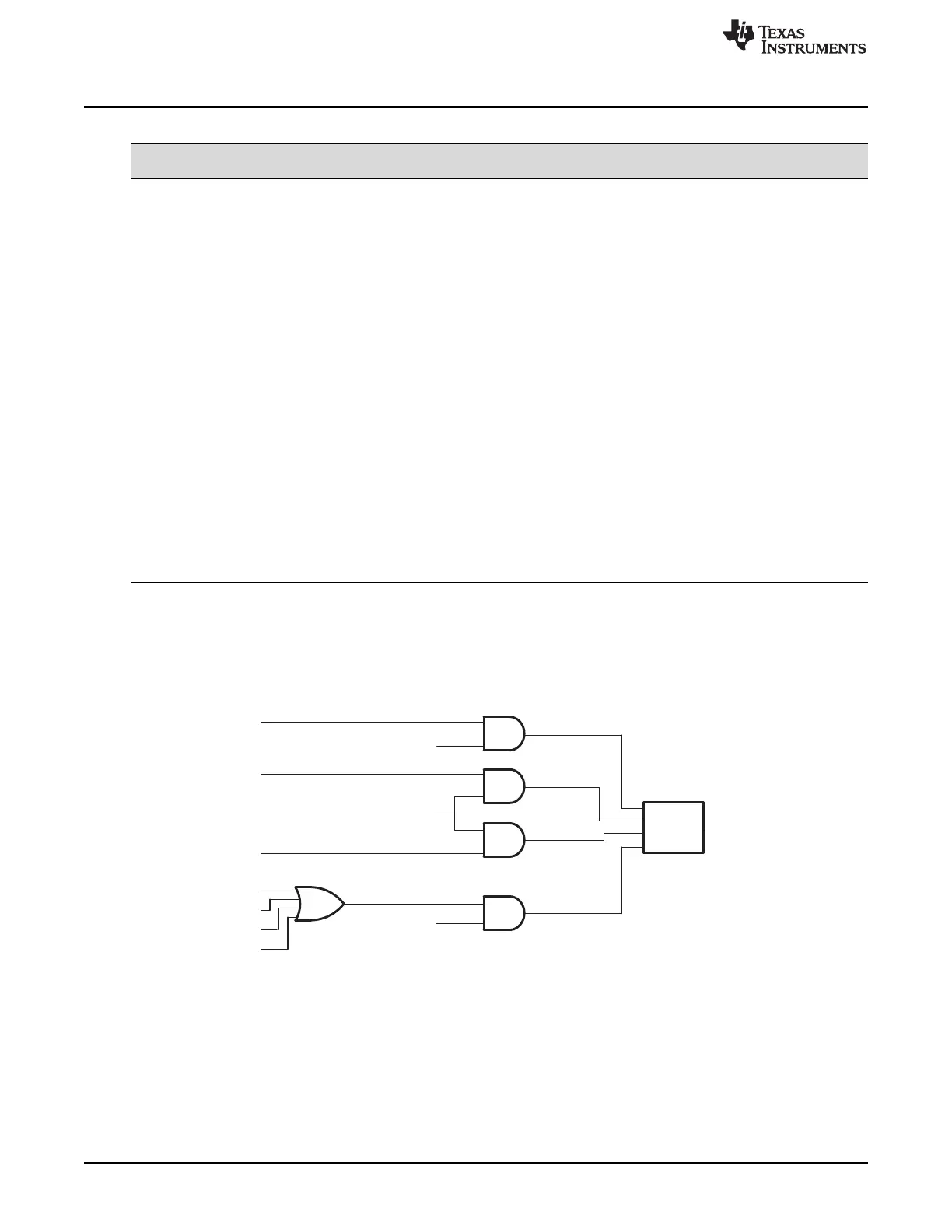
UART interrupt
request to CPU
IER(ETBEI)
IER(ERBI)
Transmitter holding
register empty
Receiver data ready
THREINT
RDRINT
Overrun error
IER(ELSI)
RTOINT
Conditions Enable bits UART interrupt requests
Arbiter
Parity error
Framing error
Break
RLSINT
Receiver time-out
Peripheral Architecture
www.ti.com
1272
SPRUH91D–March 2013–Revised September 2016
Submit Documentation Feedback
Copyright © 2013–2016, Texas Instruments Incorporated
Universal Asynchronous Receiver/Transmitter (UART)
Table 29-5. UART Interrupt Requests Descriptions
UART Interrupt
Request Interrupt Source Comment
THREINT THR-empty condition: The transmitter holding register
(THR) or the transmitter FIFO is empty. All of the data
has been copied from THR to the transmitter shift
register (TSR).
If THREINT is enabled in IER, by setting the ETBEI
bit, it is recorded in IIR.
As an alternative to using THREINT, the CPU can poll
the THRE bit in the line status register (LSR).
RDAINT Receive data available in non-FIFO mode or trigger
level reached in the FIFO mode.
If RDAINT is enabled in IER, by setting the ERBI bit,
it is recorded in IIR.
As an alternative to using RDAINT, the CPU can poll
the DR bit in the line status register (LSR). In the
FIFO mode, this is not a functionally equivalent
alternative because the DR bit does not respond to
the FIFO trigger level. The DR bit only indicates the
presence or absence of unread characters.
RTOINT Receiver time-out condition (in the FIFO mode only):
No characters have been removed from or input to
the receiver FIFO during the last four character times
(see Table 29-4), and there is at least one character
in the receiver FIFO during this time.
The receiver time-out interrupt prevents the UART
from waiting indefinitely, in the case when the receiver
FIFO level is below the trigger level and thus does not
generate a receiver data-ready interrupt.
If RTOINT is enabled in IER, by setting the ERBI bit,
it is recorded in IIR.
There is no status bit to reflect the occurrence of a
time-out condition.
RLSINT Receiver line status condition: An overrun error, parity
error, framing error, or break has occurred.
If RLSINT is enabled in IER, by setting the ELSI bit, it
is recorded in IIR.
As an alternative to using RLSINT, the CPU can poll
the following bits in the line status register (LSR):
overrun error indicator (OE), parity error indicator
(PE), framing error indicator (FE), and break indicator
(BI).
Figure 29-8. UART Interrupt Request Enable Paths



 To Next Page