PWM
t
T
PWM
T
SYSCLK
PWMresolution(%)=F /F x100%
PWM SYSCLKOUT
PWMresolution(bits)=Log (F /F )
2 PWM SYSCLKOUT
www.ti.com
Architecture
341
SPRUH91D–March 2013–Revised September 2016
Submit Documentation Feedback
Copyright © 2013–2016, Texas Instruments Incorporated
Enhanced High-Resolution Pulse-Width Modulator (eHRPWM)
14.2.10.1 Purpose of the High-Resolution PWM Submodule
The enhanced high-resolution pulse-width modulator (eHRPWM) extends the time resolution capabilities
of the conventionally derived digital pulse-width modulator (PWM). HRPWM is typically used when PWM
resolution falls below ~9-10 bits. The key features of HRPWM are:
• Extended time resolution capability
• Used in both duty cycle and phase-shift control methods
• Finer time granularity control or edge positioning using extensions to the Compare A and Phase
registers
• Implemented using the A signal path of PWM, that is, on the EPWMxA output. EPWMxB output has
conventional PWM capabilities
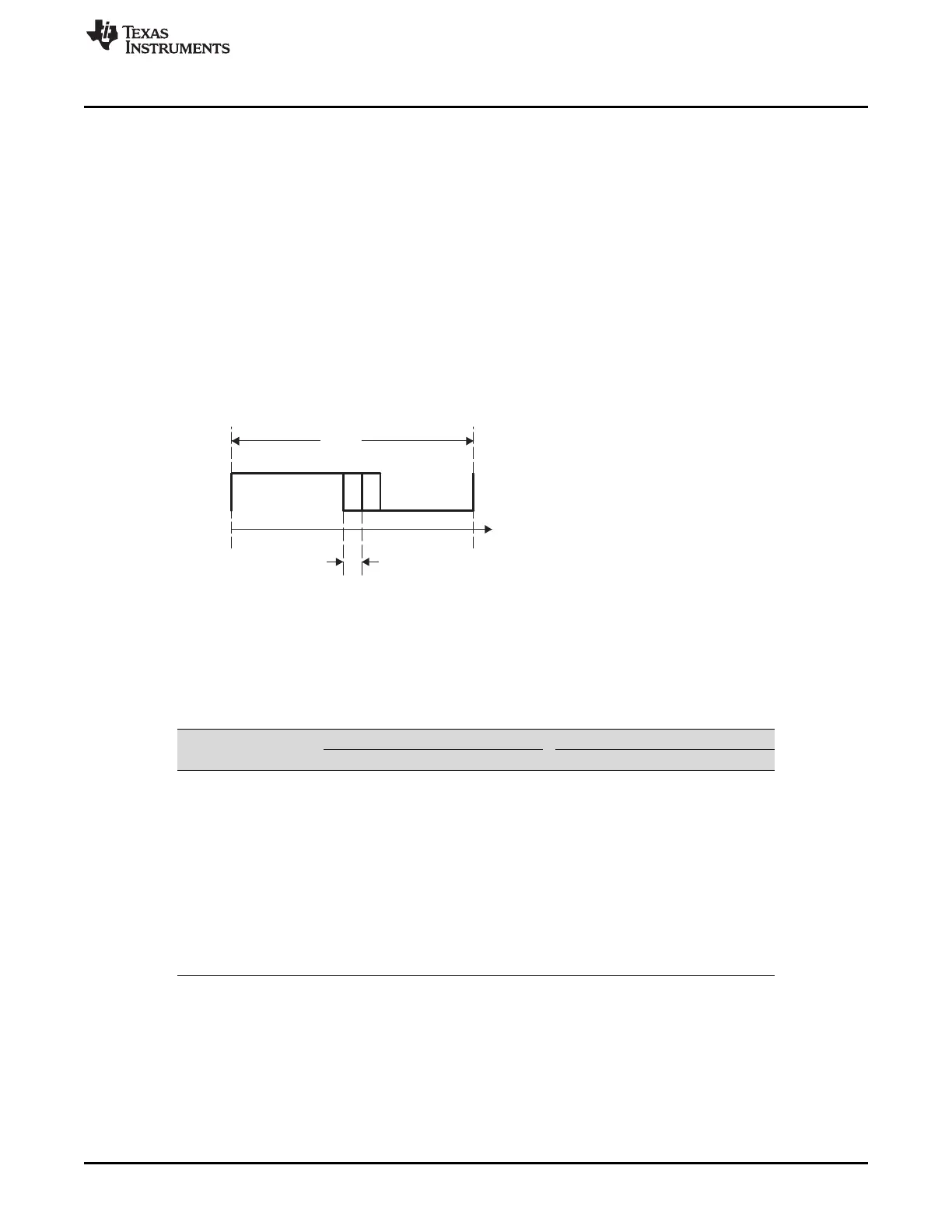
The ePWM peripheral is used to perform a function that is mathematically equivalent to a digital-to-analog
converter (DAC). As shown in Figure 14-44, the effective resolution for conventionally generated PWM is
a function of PWM frequency (or period) and system clock frequency.
Figure 14-44. Resolution Calculations for Conventionally Generated PWM
If the required PWM operating frequency does not offer sufficient resolution in PWM mode, you may want
to consider HRPWM. As an example of improved performance offered by HRPWM, Table 14-31 shows
resolution in bits for various PWM frequencies. Table 14-31 values assume a MEP step size of 180 ps.
See your device-specific data manual for typical and maximum performance specifications for the MEP.
Table 14-31. Resolution for PWM and HRPWM
PWM Frequency (kHz)
Regular Resolution (PWM) High Resolution (HRPWM)
Bits % Bits %
20 12.3 0.0 18.1 0.000
50 11.0 0.0 16.8 0.001
100 10.0 0.1 15.8 0.002
150 9.4 0.2 15.2 0.003
200 9.0 0.2 14.8 0.004
250 8.6 0.3 14.4 0.005
500 7.6 0.5 13.8 0.007
1000 6.6 1.0 12.4 0.018
1500 6.1 1.5 11.9 0.027
2000 5.6 2.0 11.4 0.036
Although each application may differ, typical low-frequency PWM operation (below 250 kHz) may not
require HRPWM. HRPWM capability is most useful for high-frequency PWM requirements of power
conversion topologies such as:
• Single-phase buck, boost, and flyback
• Multi-phase buck, boost, and flyback
• Phase-shifted full bridge
• Direct modulation of D-Class power amplifiers



 To Next Page