CEVT1
CEVT2
CEVT3
CEVT4
One−shot
control logic
Stop
CLK
RST
Modulo 4
counter
2
Mod_eq
Stop value (2b)
ECCTL2[STOP_WRAP] ECCTL2[RE−ARM]
ECCTL2[CONT/ONESHT]
0 1 32
2:4 MUX
www.ti.com
Architecture
249
SPRUH91D–March 2013–Revised September 2016
Submit Documentation Feedback
Copyright © 2013–2016, Texas Instruments Incorporated
Enhanced Capture (eCAP) Module
13.2.2.2 Edge Polarity Select and Qualifier
• Four independent edge polarity (rising edge/falling edge) selection multiplexers are used, one for each
capture event.
• Each edge (up to 4) is event qualified by the Modulo4 sequencer.
• The edge event is gated to its respective CAPn register by the Mod4 counter. The CAPn register is
loaded on the falling edge.
13.2.2.3 Continuous/One-Shot Control
• The Mod4 (2 bit) counter is incremented via edge qualified events (CEVT1-CEVT4).
• The Mod4 counter continues counting (0->1->2->3->0) and wraps around unless stopped.
• A 2-bit stop register is used to compare the Mod4 counter output, and when equal stops the Mod4
counter and inhibits further loads of the CAP1-CAP4 registers. This occurs during one-shot operation.
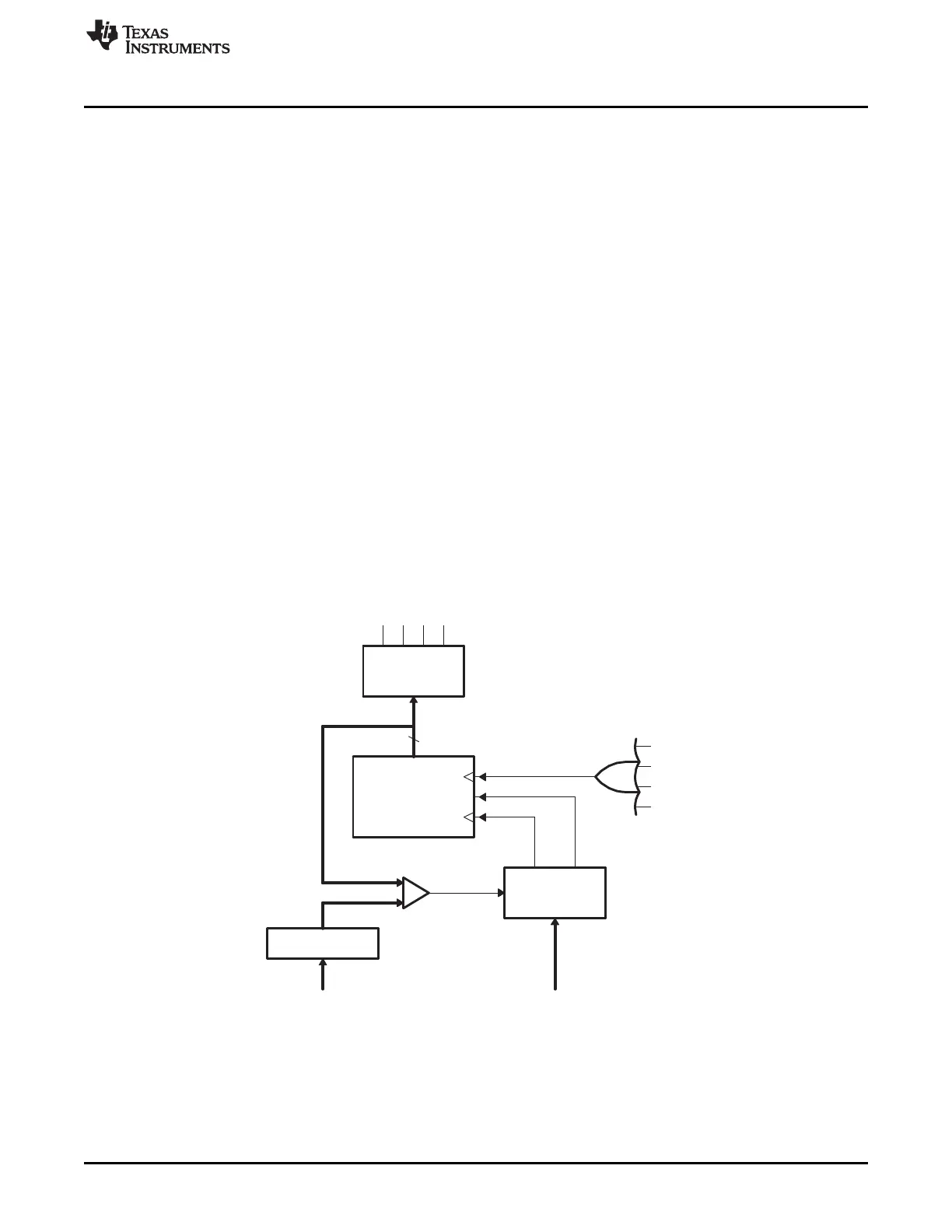
The continuous/one-shot block (Figure 13-6) controls the start/stop and reset (zero) functions of the Mod4
counter via a mono-shot type of action that can be triggered by the stop-value comparator and re-armed
via software control.
Once armed, the eCAP module waits for 1-4 (defined by stop-value) capture events before freezing both
the Mod4 counter and contents of CAP1-4 registers (time-stamps).
Re-arming prepares the eCAP module for another capture sequence. Also re-arming clears (to zero) the
Mod4 counter and permits loading of CAP1-4 registers again, providing the CAPLDEN bit is set.
In continuous mode, the Mod4 counter continues to run (0->1->2->3->0, the one-shot action is ignored,
and capture values continue to be written to CAP1-4 in a circular buffer sequence.
Figure 13-6. Continuous/One-shot Block Diagram



 To Next Page