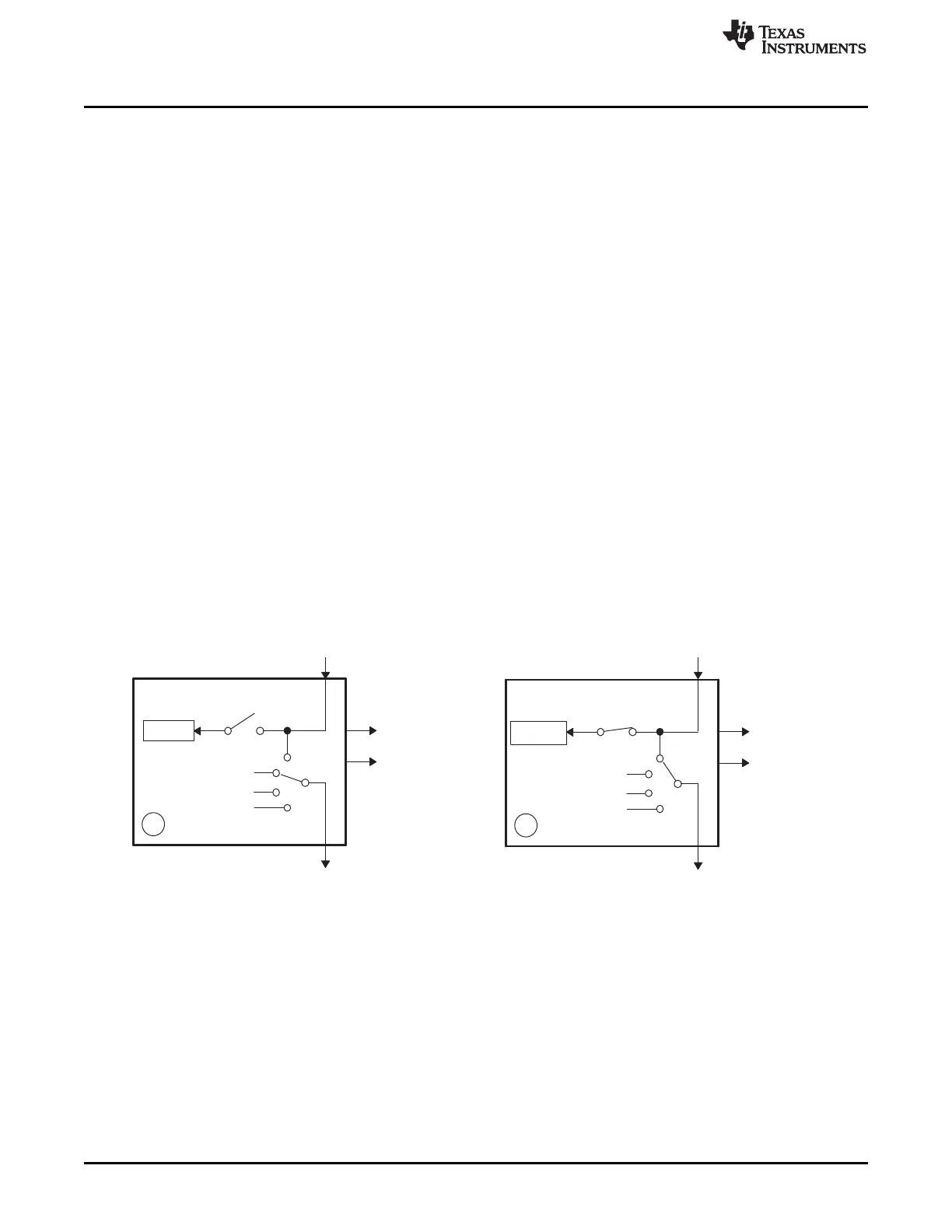
CTR=0
CTR=CMPB
X
EN
SyncOut
Phase reg
Ext SyncIn
(optional)
EPWM1A
EPWM1B
SyncOut
Phase reg
CTR=CMPB
CTR=0
X
EN
EPWM2B
EPWM2A
Slave
Master
SyncIn
SyncIn
1
2
Φ=0°
Φ=0°
Applications to Power Topologies
www.ti.com
348
SPRUH91D–March 2013–Revised September 2016
Submit Documentation Feedback
Copyright © 2013–2016, Texas Instruments Incorporated
Enhanced High-Resolution Pulse-Width Modulator (eHRPWM)
14.3.2 Key Configuration Capabilities
The key configuration choices available to each module are as follows:
• Options for SyncIn
– Load own counter with phase register on an incoming sync strobe—enable (EN) switch closed
– Do nothing or ignore incoming sync strobe—enable switch open
– Sync flow-through - SyncOut connected to SyncIn
– Master mode, provides a sync at PWM boundaries—SyncOut connected to CTR = PRD
– Master mode, provides a sync at any programmable point in time —SyncOut connected to
CTR = CMPB
– Module is in standalone mode and provides No sync to other modules—SyncOut connected to X
(disabled)
• Options for SyncOut
– Sync flow-through - SyncOut connected to SyncIn
– Master mode, provides a sync at PWM boundaries—SyncOut connected to CTR = PRD
– Master mode, provides a sync at any programmable point in time —SyncOut connected to
CTR = CMPB
– Module is in standalone mode and provides No sync to other modules—SyncOut connected to X
(disabled)
For each choice of SyncOut, a module may also choose to load its own counter with a new phase value
on a SyncIn strobe input or choose to ignore it, i.e., via the enable switch. Although various combinations
are possible, the two most common—master module and slave module modes—are shown in Figure 14-
50.
Figure 14-50. EPWM1 Configured as a Typical Master, EPWM2 Configured as a Slave



 To Next Page