www.ti.com
Registers
531
SPRUH91D–March 2013–Revised September 2016
Submit Documentation Feedback
Copyright © 2013–2016, Texas Instruments Incorporated
Enhanced Direct Memory Access (EDMA3) Controller
16.4.2.5.3 Event Set Register (ESR)
The event set register (ESR) allows the CPU (or EDMA programmers) to manually set events to initiate
DMA transfer requests. CPU writes of 1 to any event set register (En) bits set the corresponding bits in the
registers. The set event is evaluated by the EDMA3CC logic for an associated transfer request submission
to the transfer controllers. Writing a 0 has no effect.
The event set register operates independent of the event register (ER), and a write of 1 is always
considered a valid event regardless of whether the event is enabled (the corresponding event bits are set
or cleared in EER.En).
Once the event is set in the event set register, it cannot be cleared by CPU writes, in other words, the
event clear register (ECR) has no effect on the state of ESR. The bits will only be cleared once the
transfer request corresponding to the event has been submitted to the transfer controller. The setting of an
event is a higher priority relative to clear operations (via hardware). If set and clear conditions occur
concurrently, the set condition wins. If the event was previously set, then EMR would be set since an
event is lost. If the event was previously clear, then the event remains set and is prioritized for submission
to the event queues.
Manually-triggered transfers via writes to ESR allow the CPU to submit DMA requests in the system,
these are relevant for memory-to-memory transfer scenarios. If the ESR.En bit is already set and another
CPU write of 1 is attempted to the same bit, then the corresponding event is latched in the event missed
registers (EMR.En = 1).
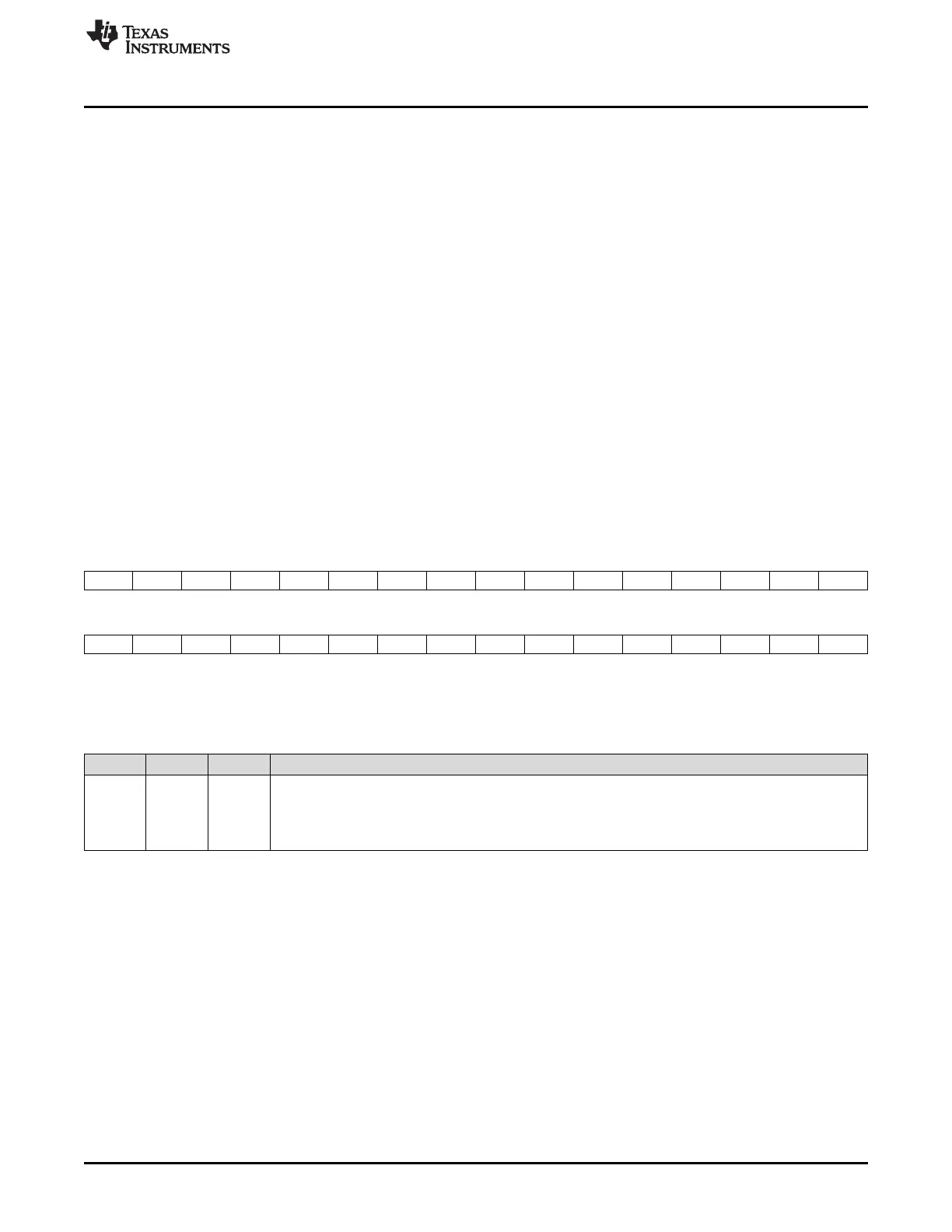
The ESR is shown in Figure 16-63 and described in Table 16-42.
Figure 16-63. Event Set Register (ESR)
31 30 29 28 27 26 25 24 23 22 21 20 19 18 17 16
E31 E30 E29 E28 E27 E26 E25 E24 E23 E22 E21 E20 E19 E18 E17 E16
R/W-0 R/W-0 R/W-0 R/W-0 R/W-0 R/W-0 R/W-0 R/W-0 R/W-0 R/W-0 R/W-0 R/W-0 R/W-0 R/W-0 R/W-0 R/W-0
15 14 13 12 11 10 9 8 7 6 5 4 3 2 1 0
E15 E14 E13 E12 E11 E10 E9 E8 E7 E6 E5 E4 E3 E2 E1 E0
R/W-0 R/W-0 R/W-0 R/W-0 R/W-0 R/W-0 R/W-0 R/W-0 R/W-0 R/W-0 R/W-0 R/W-0 R/W-0 R/W-0 R/W-0 R/W-0
LEGEND: R/W = Read/Write; -n = value after reset
Table 16-42. Event Set Register (ESR) Field Descriptions
Bit Field Value Description
31-0 En Event set for event 0-31.
0 No effect.
1 Corresponding DMA event is prioritized versus other pending DMA/QDMA events for submission to the
EDMA3TC.



 To Next Page