Write FIFO
control logic
Host write
pointer
HPI DMA
read pointer
Write FIFO
Host
writes
Read FIFO
reads
Host
control logic
Read FIFO
Host read
pointer
HPI DMA
write pointer
HPI
DMA
logic
Processor
memory
Burst
writes
reads
Burst
Architecture
www.ti.com
874
SPRUH91D–March 2013–Revised September 2016
Submit Documentation Feedback
Copyright © 2013–2016, Texas Instruments Incorporated
Host Port Interface (HPI)
21.2.6.10 FIFOs and Bursting
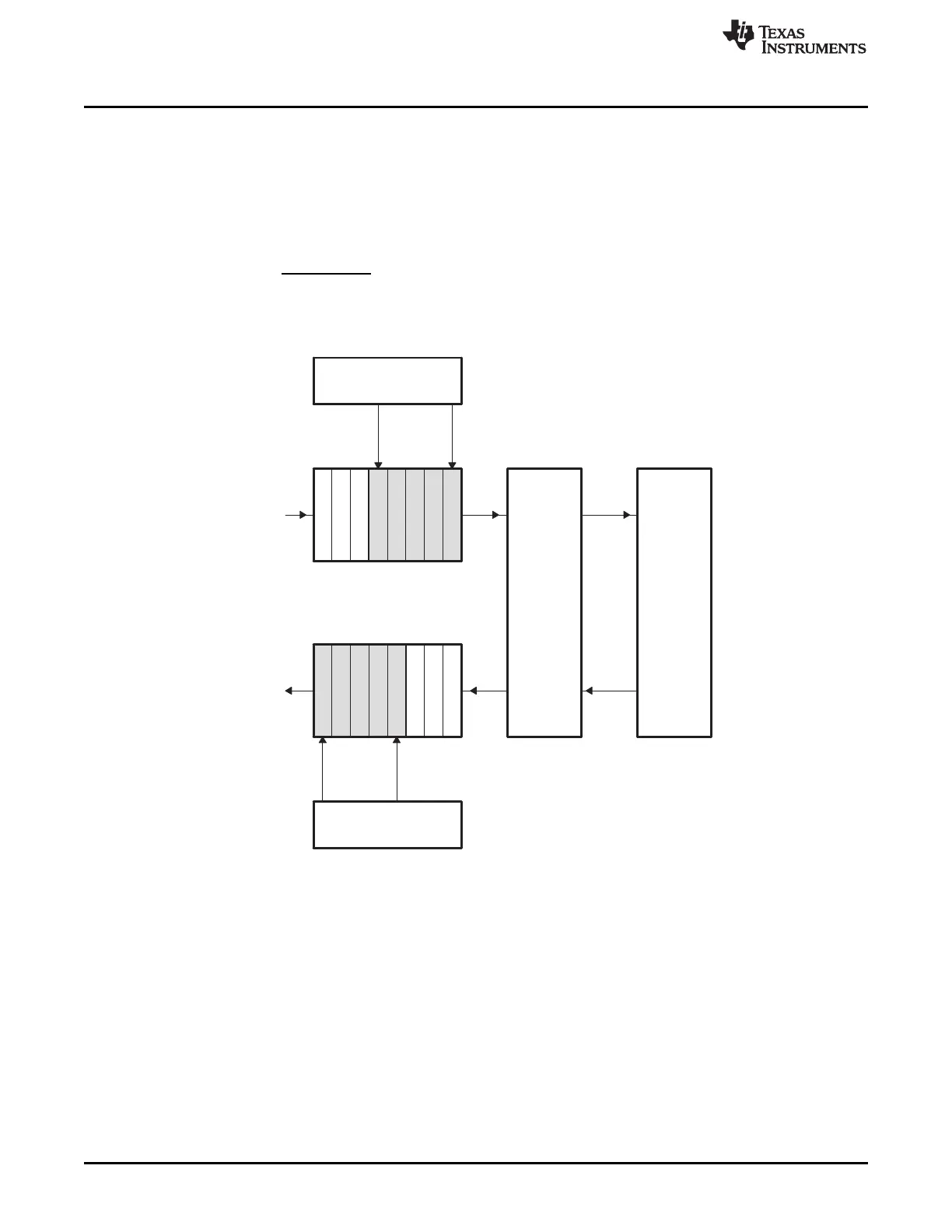
The HPI data register (HPID) is a port through which the host accesses two first-in, first-out buffers
(FIFOs). As shown in Figure 21-14, a read FIFO supports host read cycles, and a write FIFO supports
host write cycles. Both read and write FIFOs are 8-words deep (each word is 32 bits). If the host is
performing multiple reads or writes to consecutive memory addresses (autoincrement HPID cycles), the
FIFOs are used for bursting. The HPI DMA logic reads or writes a burst of four words at a time when
accessing one of the FIFOs.
Bursting is essentially invisible to the host because the host interface signaling is not affected. Its benefit
to the host is that the UHPI_HRDY signal is deasserted less often when there are multiple reads or writes
to consecutive addresses.
Figure 21-14. FIFOs in the HPI



 To Next Page