Chapter 15: Interface IP Configuration
STANDARD Revision 1.0 C4® CMTS Release 8.3 User Guide
© 2016 ARRIS Enterprises LLC. All Rights Reserved. 437
respectively). Each physical network interface may have from 0 to 255 subinterfaces defined. Each encapsulated
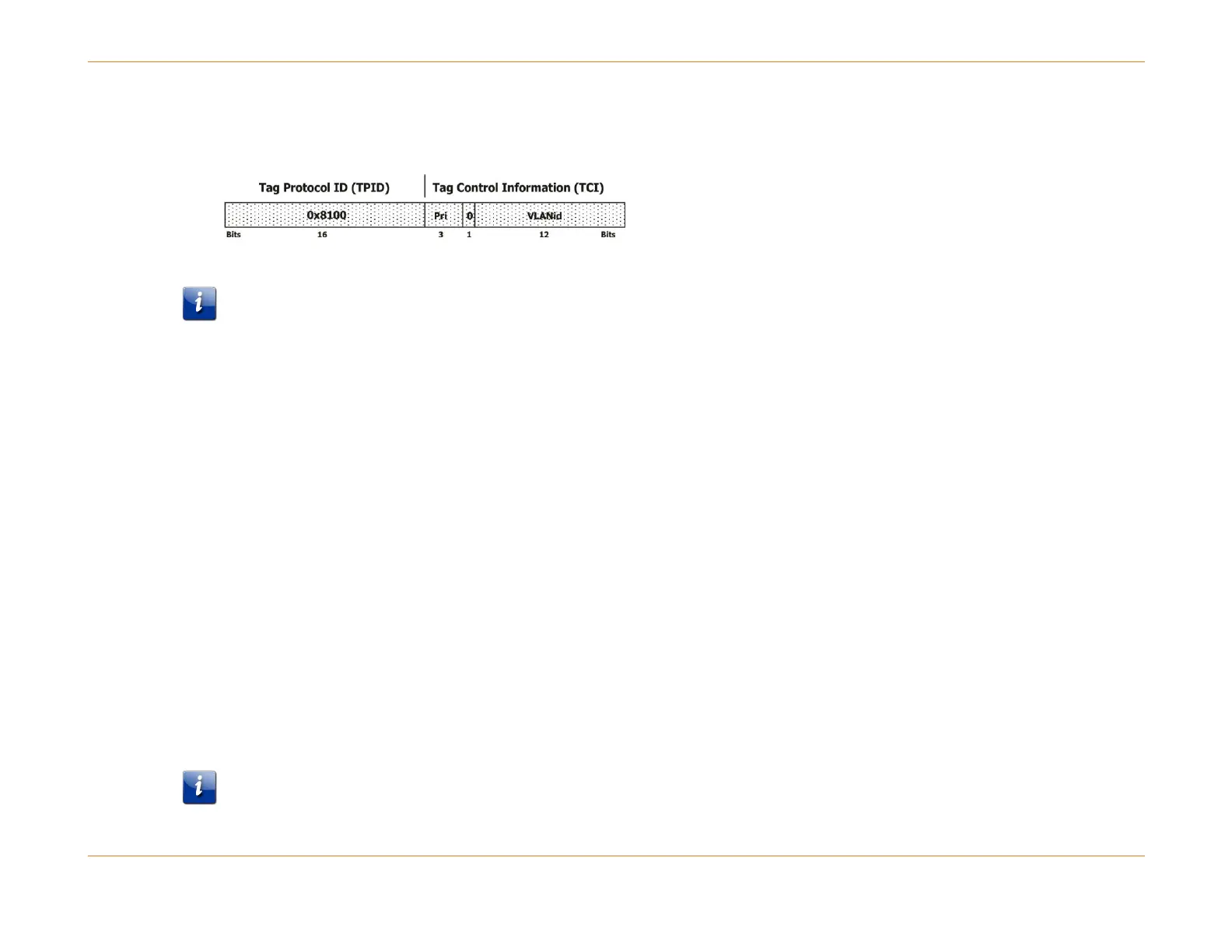
subinterface then behaves like a separate physical interface with the Q-tag as the VC identifier:
Figure 78: IEEE 802.1Q/p Tag Format
Note: This feature does not provide true VLAN support as defined by IEEE 802.1Q for switching tagged ethernet frames
between ports. It merely uses the Q-tag as a means to multiplex multiple ethernet VCs onto a single physical ethernet link.
Q-tags also carry the IEEE 802.1p priority (p-bits). The network subinterface can assign either a fixed priority value to the p-
bits for all egress Q-tags or a dynamic bi-directional mapping between the IP TOS precedence bits and the Q-tag p-bits for
ingress and egress IP frames. Otherwise, the egress p-bits are set to zero by default and ingress p-bits are ignored.
IP TOS precedence bits, IP Differentiated Services Code Point (DSCP) bits, Class Selector (CS) bits, and 802.1p priority bits
are all defined identically and therefore may be interchanged without any conversion. This capability makes it possible for
intervening layer 2 switches to give the appropriate Quality of Service (QoS) treatment to ethernet frames being switched
between adjacent routers. Also, the DOCSIS 2.0 service flow TOS overwrite capability may be used to impose a TOS byte on
IP frames forwarded by cable modems to the C4/c CMTS based on flow classification rules. Thus, dynamic IP TOS
precedence bit mapping to Q-tag p-bits at the network subinterfaces allows DOCSIS priorities to be propagated through
the adjacent network side layer 2 switches.
For more information, see IEEE standard 802.1Q, Virtual Bridged Local Area Networks, at
http://standards.ieee.org/getieee802/802.1.html.
One Q-tag per Network Interface
This feature supports only the static configuration of one Q-tag per network subinterface. To avoid fragmentation, only
one Q-tag (adding only 32 bits) will be imposed on the egress frame by the RCM port creating a maximum ether frame size
of 1522 octets when a Q-tag is present.
Note: The ARRIS Q-tag feature provides Virtual Circuit (VC) identity to the RCM ports. It does not support VLAN switching
between RCM ports or CAM ports.



 To Next Page